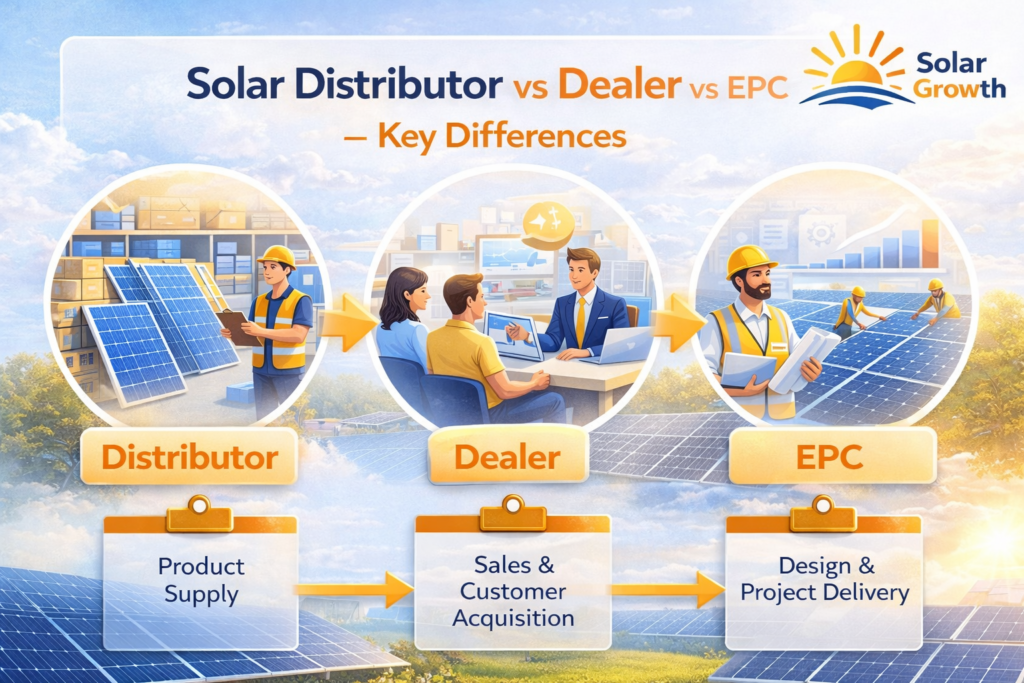
The solar industry continues to expand rapidly as governments promote clean energy and businesses seek cost effective power solutions. With utility scale projects, commercial rooftops, and residential systems growing steadily in 2026, many people entering the industry are confused about the roles of a solar distributor, dealer, and EPC. While these terms are often used interchangeably, they represent very different functions within the solar value chain.
Understanding these distinctions is essential whether you are a manufacturer, investor, installer, or end customer.
What Is a Solar Distributor?
A solar distributor acts as a wholesale intermediary between manufacturers and downstream partners such as dealers, installers, and EPC companies. Distributors typically purchase solar panels, inverters, mounting structures, batteries, and balance of system components in bulk directly from manufacturers.
Their primary role is supply chain management. They handle logistics, warehousing, inventory management, and credit support for smaller buyers. Many distributors also provide technical training, warranty assistance, and product guidance.
In today’s market, strong distributors differentiate themselves by offering multi brand portfolios, faster delivery cycles, and digital ordering platforms. With increasing demand for Tier 1 modules, hybrid inverters, and energy storage solutions, distributors play a crucial role in ensuring product availability and price stability.
What Is a Solar Dealer?
A solar dealer is typically closer to the end customer. Dealers focus on sales and customer acquisition rather than large scale procurement. They may source products from distributors and then sell complete solar systems to residential or small commercial customers.
Dealers often manage site surveys, quotations, financing guidance, and basic coordination of installation. In many cases, they partner with local installers or subcontractors to execute the physical installation.
In 2026, many solar dealers are adopting digital marketing, CRM systems, and financing partnerships to remain competitive. Customer experience has become a key differentiator, with transparent pricing and after sales service playing an increasingly important role.
What Is an EPC in Solar?
EPC stands for Engineering, Procurement, and Construction. An EPC company provides end to end solar project execution. Unlike distributors and dealers, EPC firms manage the complete lifecycle of a solar project.
Engineering includes system design, load calculations, plant layout, and compliance with grid standards. Procurement involves sourcing modules, inverters, and other equipment from distributors or directly from manufacturers. Construction covers installation, testing, commissioning, and handover.
EPC companies typically handle larger projects such as commercial, industrial, or utility scale solar plants. They are responsible for timelines, technical performance, and often long term maintenance contracts.
With the growth of megawatt scale rooftop and ground mounted systems, EPC firms now integrate advanced monitoring systems, AI driven performance analytics, and hybrid storage solutions into their offerings.
Key Differences at a Glance
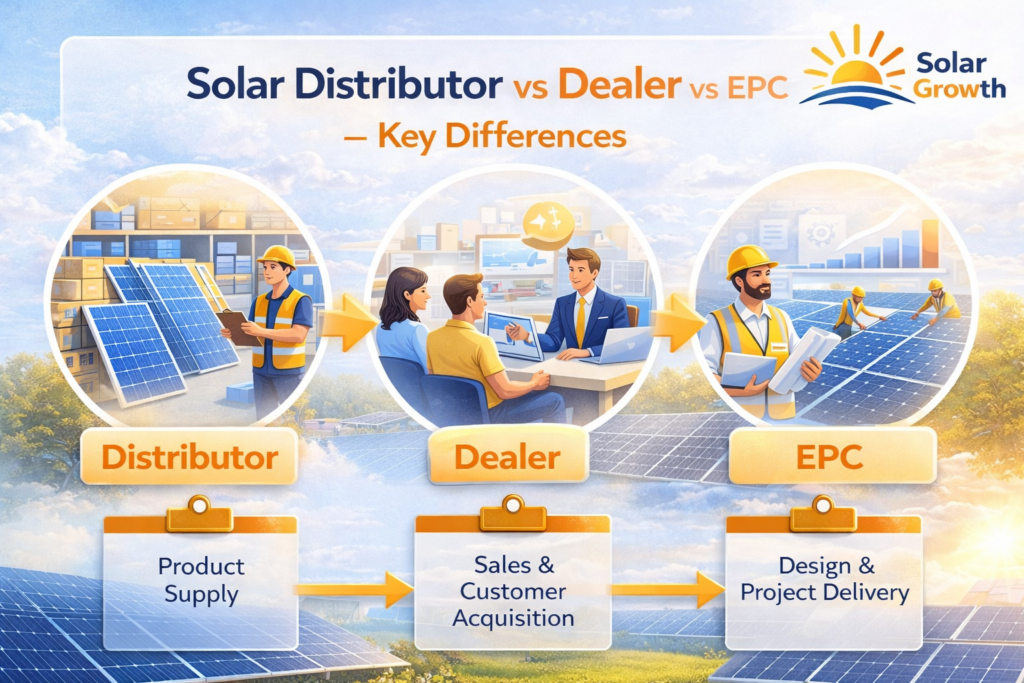
The core difference lies in responsibility and scale.
A distributor focuses on product supply and logistics.
A dealer focuses on sales and customer acquisition.
An EPC focuses on complete project delivery from design to commissioning.
Distributors operate upstream in the supply chain. Dealers operate at the customer interface level. EPCs operate across the entire project lifecycle.
Which One Should You Work With?
The answer depends on your objective.
If you are an installer or reseller looking for product access and competitive pricing, a distributor is your best partner.
If you are a homeowner or small business owner looking to install a rooftop system, a dealer can guide you through system selection and financing.
If you are planning a large commercial or industrial solar plant, an experienced EPC company is essential to ensure technical accuracy and project efficiency.
As the solar market matures, collaboration between these three roles has become more structured. Clear contracts, performance guarantees, and digital tracking tools are now standard in professional projects.
Frequently Asked Questions
1. Can a solar distributor also act as an EPC?
In some cases, yes. Larger distributors sometimes expand vertically and offer EPC services. However, their core expertise usually remains in procurement and supply chain management.
2. Do dealers install solar systems themselves?
Some dealers have in house installation teams, while others subcontract installations to licensed installers or EPC partners.
3. Who offers warranty support in a solar project?
Product warranties are provided by manufacturers. Installation and performance warranties are usually handled by the EPC or dealer who executed the project.
4. Is EPC only for large projects?
EPC is more common in commercial and utility scale projects, but many EPC companies also handle medium sized rooftop systems.
5. Which model is most profitable in the solar industry?
Profitability depends on scale, operational efficiency, and market positioning. Distributors benefit from volume margins, dealers from sales commissions and customer relationships, and EPCs from project execution margins.