Introduction
For commercial and industrial (C&I) businesses in India, electricity is one of the largest operating expenses. Tariffs in many states range from ₹7 to ₹11 per unit, and they increase annually.
Commercial rooftop solar in India offers businesses a way to lock in lower energy costs for 20-25 years. But before investing, decision-makers want clear answers:
- What is the total cost?
- What is the expected ROI?
- How long is the payback period?
This guide breaks down commercial solar cost in India, realistic ROI calculations, and industry benchmarks with practical examples.
However, the actual ROI depends heavily on selecting the right EPC partner for system design and execution
What Is Commercial Rooftop Solar?
Commercial rooftop solar refers to solar PV systems installed on factory, warehouse, hospital, mall, or office rooftops for captive consumption.
Unlike residential systems, C&I projects:
- Are larger in size (50 kW to several MW)
- Offset high-tariff commercial power
- Deliver stronger ROI
- Require structural and load analysis
Most C&I rooftop systems operate under net metering or captive consumption models.
Commercial Rooftop Solar Cost in India (2026 Benchmarks)
The cost depends on system size, module type, inverter brand, and installation complexity.
Typical Cost Range (Without Subsidy)
| System Size | Cost per kW (₹) | Total Cost Estimate |
| 50 kW | ₹40,000–₹48,000 | ₹20–24 lakh |
| 100 kW | ₹38,000–₹45,000 | ₹38–45 lakh |
| 500 kW | ₹34,000–₹42,000 | ₹1.7–2.1 crore |
| 1 MW | ₹32,000–₹40,000 | ₹3.2 – 4 crore |
Prices vary by state and mounting complexity.
Many businesses also explore alternative models like power purchase agreements to reduce upfront investment.
What Influences Cost?
- Module technology (Mono PERC, TOPCon, Bifacial)
- Roof type (RCC vs metal sheet)
- Shadow conditions
- Inverter selection
- Transformer requirements (for larger plants)
Large-scale projects benefit from economies of scale.
How to Calculate Commercial Solar ROI
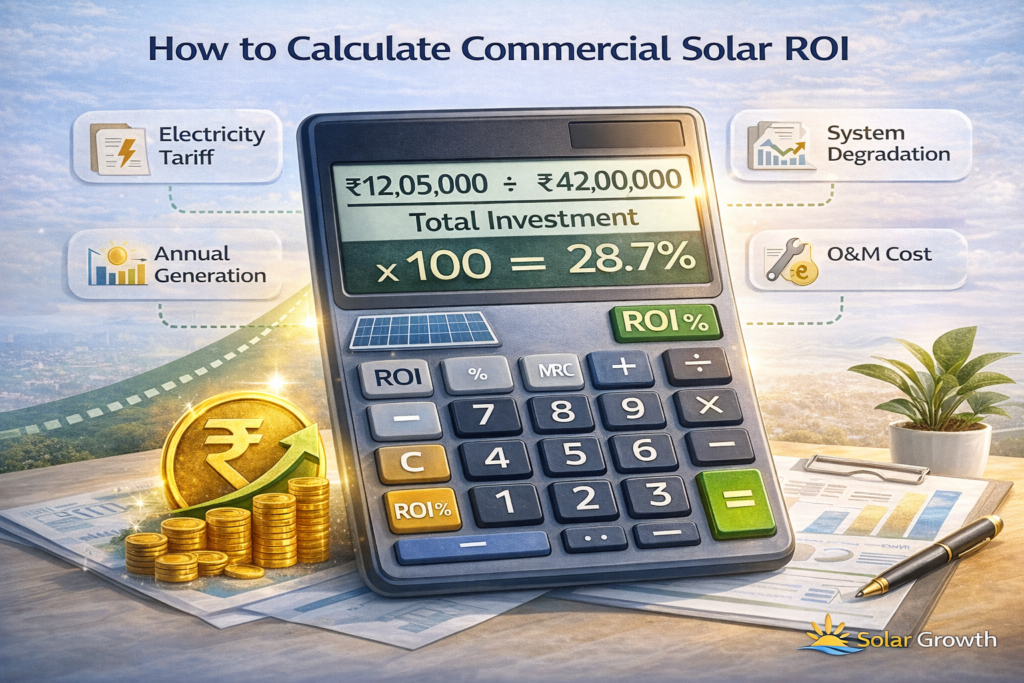
Return on Investment (ROI) depends on:
- Electricity tariff
- Annual generation
- System degradation
- O&M cost
- Financing structure
Basic ROI Formula
Annual Savings ÷ Total Investment × 100
But that’s simplified. Serious evaluation requires 20–25 year cashflow modelling.
Example: 100 kW Commercial Rooftop Solar in Maharashtra
Assumptions:
- System cost: ₹42 lakh
- Average generation: 1,45,000 units/year
- Commercial tariff: ₹9 per unit
- O&M cost: ₹1 lakh/year
- Degradation: 0.55% annually
Year 1 Savings:
1,45,000 × ₹9 = ₹13,05,000
Net after O&M ≈ ₹12,05,000
Simple Payback:
₹42,00,000 ÷ ₹12,05,000 ≈ 3.5 years
After payback, electricity becomes virtually free except O&M.
Commercial Solar Payback Period in India
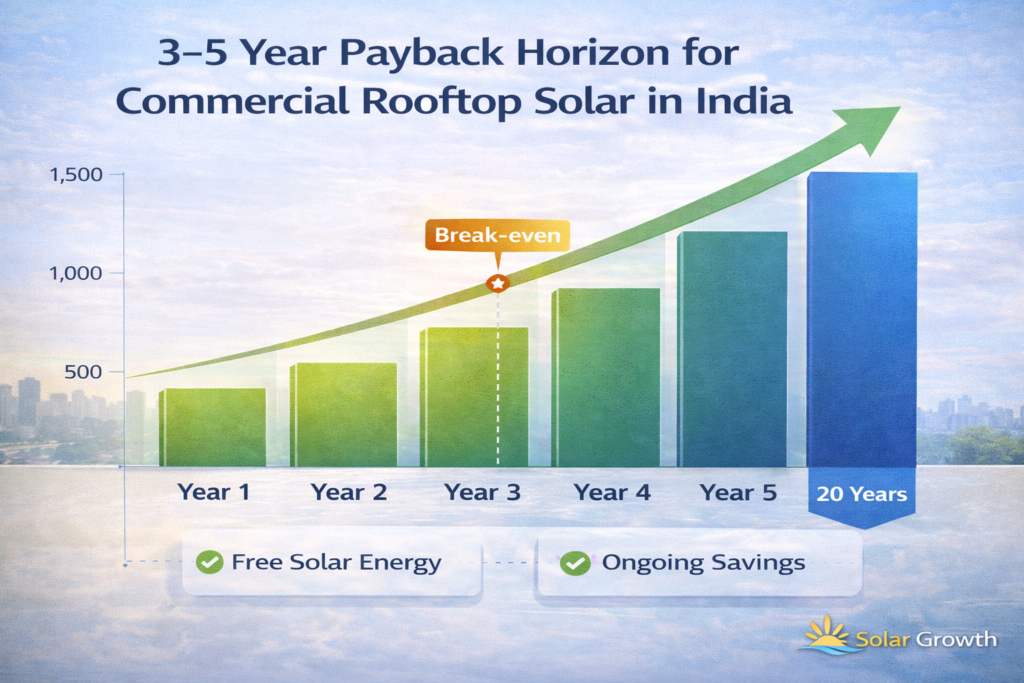
In most states, commercial solar payback ranges between:
3 to 5 years
Why is it so attractive?
Because C&I tariffs are high. The higher your grid tariff, the faster the payback.
State-Level Impact
| State | Avg Commercial Tariff | Expected Payback |
| Maharashtra | ₹8–₹10 | 3–4 years |
| Karnataka | ₹7–₹9 | 4–5 years |
| Tamil Nadu | ₹7–₹9 | 3.5–4.5 years |
| Gujarat | ₹6–₹8 | 4–5 years |
High tariffs = stronger ROI.
20-Year ROI Perspective
Solar panels typically last 25 years.
Assume:
- 4-year payback
- 21 additional years of savings
- Modest degradation
Total lifetime savings often reach 3–5 times the initial investment.
That’s a long-term internal rate of return (IRR) between 18%–25% in many cases.
Few financial instruments offer that stability.
Key Factors That Improve ROI
1. High Daytime Load
Solar works best when your facility consumes power during the day.
Factories and warehouses benefit more than offices with low daytime load.
2. Strong Roof Structure
Minimal reinforcement reduces installation cost.
3. Net Metering Approval
Enables export of excess generation.
4. Quality EPC Partner
Poor installation reduces output.
For margin and EPC selection insights, see Solar EPC Margins Explained.
Common Mistakes That Reduce Commercial Solar ROI
- Choosing cheapest EPC without quality checks
- Ignoring roof structural study
- Overestimating generation
- Not factoring degradation
- Poor maintenance planning
ROI depends on disciplined execution.
Financing Options for Commercial Rooftop Solar
1. Capex Model
Business invests upfront. Highest ROI.
2. Opex / RESCO Model
Third-party investors. Business pays per unit.
Lower risk, lower savings.
3. Bank Financing
Many Indian banks offer solar loans at competitive rates.
Interest must be included in ROI calculation.
Technical Standards & Compliance (India)
Quality C&I rooftop systems should comply with:
- IEC 61215 (module performance)
- IEC 61730 (safety standard)
- MNRE ALMM requirements
- DISCOM net metering guidelines
Compliance protects eligibility and long-term performance.
For quality checks, read How to Avoid Fake or Low-Quality Solar Panels in India.
Operational & Maintenance Costs
O&M is usually:
- ₹800–₹1,500 per kW annually
Includes:
- Cleaning
- Inverter monitoring
- Preventive inspection
- Performance tracking
Neglecting O&M reduces ROI.
Real Industry Trend
In India’s C&I sector:
- Manufacturing plants lead adoption
- Warehouses follow closely
- Data centers increasingly shift to solar
Rising carbon compliance requirements further accelerate adoption.
Is Commercial Rooftop Solar Still Worth It in 2026?
Yes if:
- Tariffs exceed ₹6 per unit
- Roof area is sufficient
- Load profile matches generation
Solar remains one of the highest-ROI infrastructure investments for Indian businesses.
Conclusion
Commercial rooftop solar in India offers strong financial returns when planned correctly. With installation costs between ₹32,000–₹45,000 per kW and payback periods of 3–5 years, most C&I projects deliver compelling ROI.
But success depends on:
- Accurate generation estimates
- Quality EPC selection
- Compliance adherence
- Proper O&M
Solar is not just a green decision. It is a strategic financial one.
Reduce Your Business Electricity Costs with Solar
Commercial solar projects require the right planning, pricing, and execution to achieve the expected ROI and payback.
Sign up with us to get a customized solar solution and ROI analysis for your business. Free Registration – Solar Growth
FAQs
1. What is the average cost of commercial rooftop solar in India?
Typically ₹32,000 to ₹45,000 per kW depending on system size and complexity.
2. What is the payback period for commercial solar?
Usually 3–5 years in most Indian states.
3. Does commercial rooftop solar require subsidy?
Most C&I systems operate without subsidy. ROI remains strong due to high tariffs.
4. Is net metering available for commercial solar?
Yes, subject to state DISCOM policies and capacity limits.
Written by Rohith Bingi
Solar Industry Analyst at Solar Growth, covering India’s solar value chain, policy landscape, and business growth trends