Introduction
Electricity costs are one of the largest operational expenses for businesses in India. With rising tariffs and increasing sustainability goals, many companies are exploring solar power to reduce long-term energy costs.
Two popular models for commercial solar procurement are captive solar and group captive solar. Both models allow businesses to access renewable power at lower costs compared to traditional grid electricity.
However, these models differ significantly in terms of ownership, investment, regulatory structure, and financial benefits.
This guide explains the difference between captive and group captive solar models in India, including cost implications, regulatory requirements, real-world examples, and how businesses can choose the right option.
Understanding Captive Solar Power
Captive solar refers to a solar power plant owned and operated by a single company primarily for its own electricity consumption.
The plant can be located:
- On the company’s rooftop
- Within the company premises
- At an offsite location connected through open access
Key Characteristics of Captive Solar
- 100% ownership by the consumer company
- Electricity generated for self-consumption
- Full control over the power plant
- High initial capital investment
Companies adopting captive solar typically install systems ranging from 100 kW to several MW, depending on energy demand.
Understanding Group Captive Solar
Group captive solar allows multiple businesses to jointly invest in a solar power plant and consume electricity generated from it.
This model is governed by specific regulatory requirements under Indian electricity laws.
Key Regulatory Conditions
To qualify as group captive:
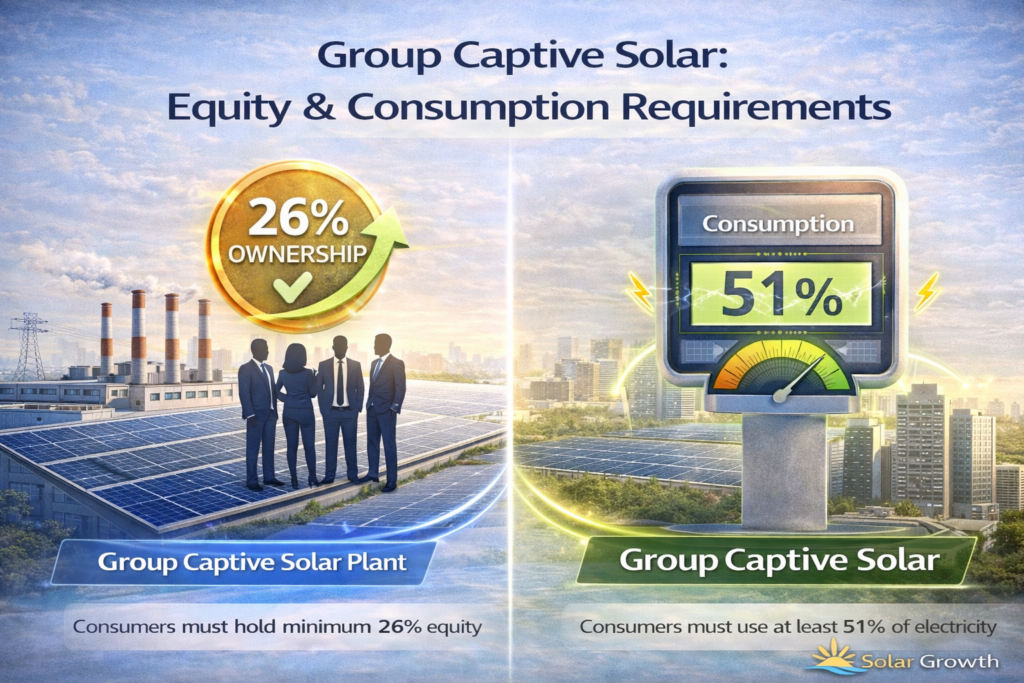
- Consumers must hold at least 26% equity ownership in the power plant
- Consumers must collectively consume at least 51% of the electricity generated
If these conditions are met, consumers can receive open access charge exemptions in many states.
Why Businesses Use Captive or Group Captive Solar
Both models are designed to reduce electricity costs while enabling renewable energy adoption.
Common business objectives include:
- Lower power tariffs
- Long-term energy price stability
- Meeting sustainability commitments
- Reducing carbon footprint
Companies with large power consumption benefit the most from these models.
Captive vs Group Captive Solar Key Differences
| Factor | Captive Solar | Group Captive Solar |
| Ownership | Single company | Multiple investors |
| Investment | High upfront cost | Shared investment |
| Control | Full operational control | Limited control |
| Regulatory conditions | Simpler compliance | Must meet equity and consumption rules |
| Power supply model | Self-consumption | Shared energy allocation |
| Risk exposure | Higher financial risk | Shared risk |
The right model depends on company size, investment capacity, and power demand.
Cost Comparison: Captive vs Group Captive Solar
Captive Solar Cost
Businesses must invest the entire project cost.
Typical solar plant cost in India:
₹3.5 crore – ₹4.5 crore per MW
Advantages:
- Full ownership
- Maximum long-term savings
- Asset creation
Disadvantages:
- High upfront capital requirement
- Maintenance responsibility
Group Captive Solar Cost
Investment is shared among participating companies.
Typical investment share:
- 26% equity investment requirement
- Remaining funded by project developer or lenders
Advantages:
- Lower upfront capital
- Access to solar without owning full plant
- Reduced operational responsibility
Disadvantages:
- Less control over project operations
- Compliance with group captive regulation
Electricity Cost Savings Comparison
Businesses typically achieve the following tariff reductions:
| Model | Typical Power Cost |
| Grid electricity | ₹7–₹11 per unit |
| Captive solar | ₹3–₹4 per unit |
| Group captive solar | ₹4–₹5 per unit |
This means businesses can reduce electricity costs by 30–50% depending on state policies and tariffs.
Example Scenario
A manufacturing company consuming 2 million units annually pays ₹9 per unit from the grid.
Annual Electricity Cost
₹1.8 crore per year
If the company adopts group captive solar at ₹4.5 per unit:
Annual electricity cost becomes:
₹90 lakh
Annual Savings
₹90 lakh
Over 20 years, total savings can exceed ₹15–18 crore depending on tariff escalation.
Regulatory Framework for Group Captive Solar
Group captive solar is governed by rules under the Electricity Act 2003.
Key regulatory requirements include:
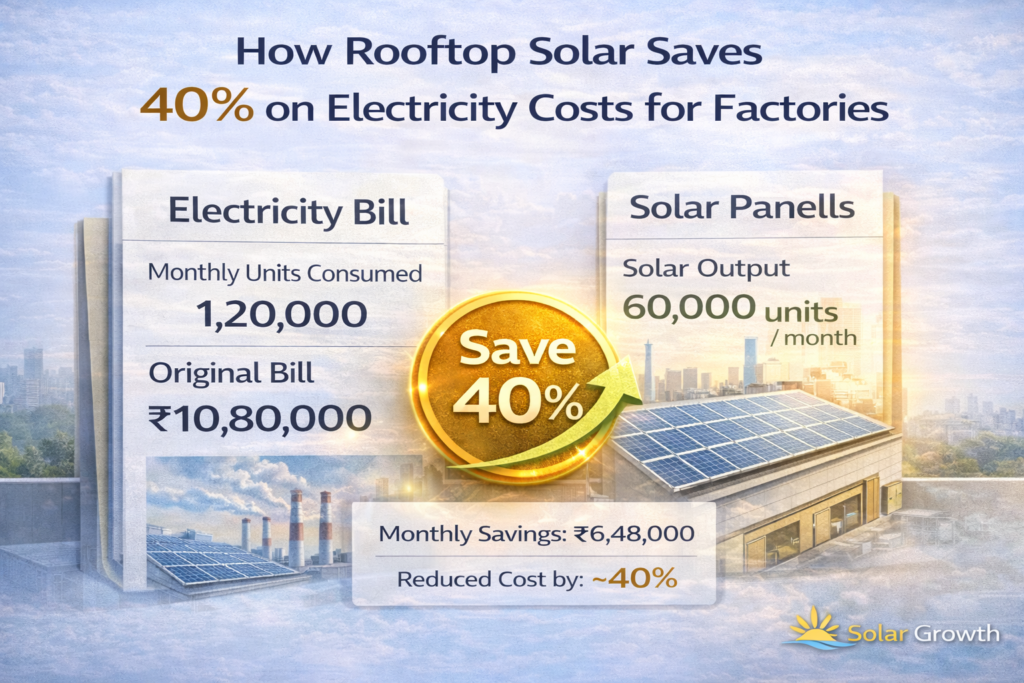
- Minimum 26% equity ownership by captive users
- Minimum 51% consumption by captive users
- Compliance with open access regulations
Failure to meet these conditions can result in loss of open access exemptions and higher electricity charges.
Businesses should verify compliance carefully.
Factors Businesses Should Evaluate
When deciding between captive and group captive solar, companies should evaluate several factors.
Investment Capacity
Companies with strong capital reserves may prefer captive solar.
Power Demand
Businesses with high energy consumption benefit more from captive models.
Risk Appetite
Group captive reduces investment risk through shared ownership.
Operational Control
Captive plants provide full control over system design and performance.
Common Mistakes Businesses Make
Businesses evaluating solar procurement often make avoidable mistakes.
Common errors include:
- Ignoring regulatory compliance for group captive
- Underestimating transmission losses
- Choosing developers without strong track record
- Overlooking long-term contract terms
Proper due diligence is essential before signing power purchase agreements.
Best Practices for Businesses
To maximize benefits from solar procurement models, businesses should follow industry best practices.
Conduct Energy Consumption Analysis
Understand load profile and annual demand.
Evaluate Financial Models
Compare capex investment vs power purchase agreements.
Assess Developer Credibility
Choose experienced solar developers with proven project execution.
Monitor Regulatory Updates
Open access policies differ across Indian states and evolve frequently.
Industry Adoption Trends in India
Captive and group captive solar adoption is increasing across sectors such as:
- Manufacturing
- Warehousing and logistics
- Automotive industry
- IT campuses
- Data centers
Large corporations increasingly adopt group captive solar to meet renewable energy targets while reducing electricity costs.
Conclusion
Both captive and group captive solar models offer significant cost savings and long-term energy stability for businesses in India.
Captive solar is ideal for companies with sufficient capital and high power demand who want full ownership and maximum long-term returns.
Group captive solar is better suited for companies seeking lower upfront investment while still benefiting from renewable energy and reduced tariffs.
Choosing the right model requires careful evaluation of energy consumption, investment capability, regulatory requirements, and long-term sustainability goals.
FAQs
1. What is the difference between captive and group captive solar?
Captive solar is owned by a single company for its own electricity consumption, while group captive solar involves multiple businesses jointly owning and consuming electricity from a solar plant.
2. How much equity is required in group captive solar?
Businesses must collectively hold at least 26% ownership in the power plant.
3. What consumption requirement applies to group captive solar?
Captive consumers must use at least 51% of the electricity generated.
4. Which model offers better cost savings?
Captive solar usually provides slightly lower electricity costs, but group captive offers lower investment requirements and shared risk.
Written by Rohith Bingi
Solar Industry Analyst at Solar Growth, covering India’s solar value chain, policy landscape, and business growth trends