Introduction
Businesses across India are increasingly adopting solar energy to reduce electricity costs and improve sustainability performance. However, beyond operational savings, solar power also offers significant tax advantages for companies.
Government policies encourage renewable energy adoption through financial incentives such as accelerated depreciation and favorable GST treatment. These tax benefits can significantly improve the financial viability of commercial solar projects.
For many businesses, the tax savings from solar installations reduce the effective project cost and shorten the payback period.
This guide explains the key tax benefits available for solar installations in India, including accelerated depreciation, GST implications, and how businesses can maximize financial returns from solar investments.
Why Tax Incentives Exist for Solar Energy
Governments promote renewable energy to achieve environmental and energy security goals.
In India, solar incentives aim to:
- Encourage businesses to adopt renewable energy
- Reduce carbon emissions
- Lower dependence on fossil fuels
- Promote sustainable industrial growth
Tax incentives make solar investments more attractive by improving project economics.
Major Tax Benefits of Solar for Businesses
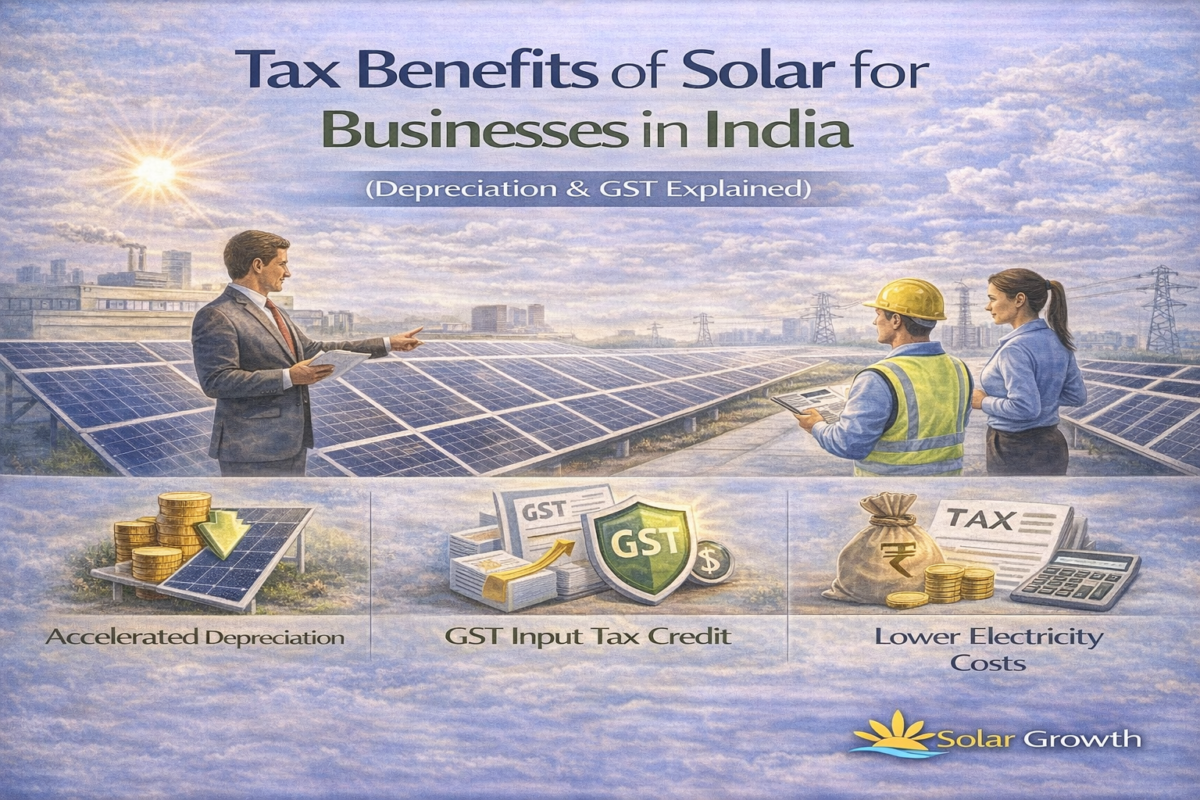
Businesses installing solar power systems in India may benefit from several tax advantages.
The most important ones include:
- Accelerated depreciation benefits
- GST input tax credit
- Reduced electricity costs and taxable income
- Other state-level incentives
Understanding these benefits helps companies evaluate the true financial return of solar projects.
Accelerated Depreciation Benefit for Solar
Accelerated depreciation (AD) is one of the most important financial incentives for commercial solar projects in India.
Depreciation allows businesses to reduce taxable income by deducting the asset’s value over time.
Solar power systems qualify for accelerated depreciation under the Income Tax Act.
Current Depreciation Rate
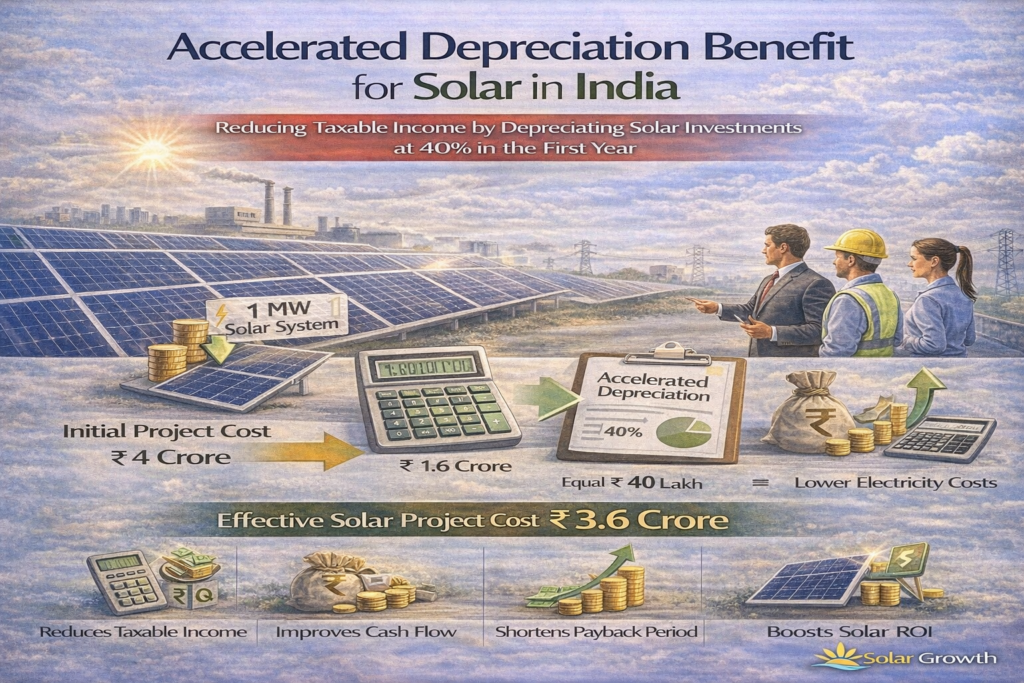
Commercial solar projects typically qualify for 40% depreciation in the first year.
This allows businesses to write off a significant portion of the system cost early.
Example: Accelerated Depreciation Savings
Consider a business installing a 1 MW rooftop solar system costing ₹4 crore.
First-Year Depreciation
40% depreciation = ₹1.6 crore
If the company pays 25% corporate tax, the tax saving becomes:
₹1.6 crore × 25% = ₹40 lakh
This significantly reduces the effective project cost.
Effective Solar Project Cost
Original project cost = ₹4 crore
Tax savings = ₹40 lakh
Effective cost = ₹3.6 crore
This tax benefit improves the solar project’s ROI.
GST Implications for Solar Projects
Solar power systems in India are subject to Goods and Services Tax (GST).
GST Rate on Solar Equipment
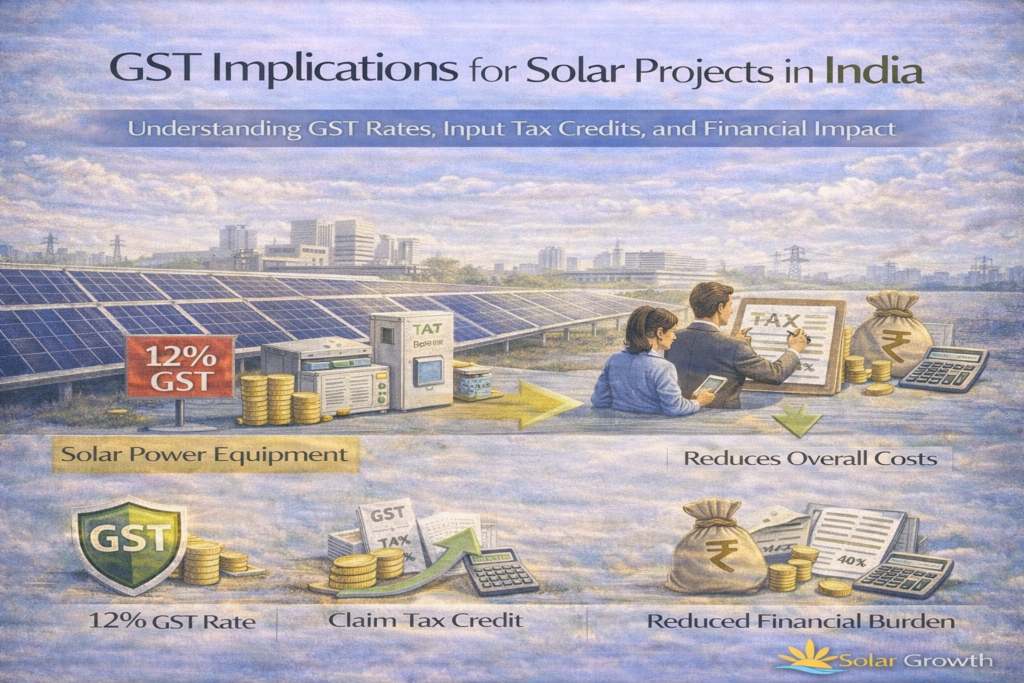
Solar power generating systems are taxed at 12% GST.
This applies to components such as:
- Solar panels
- Inverters
- Mounting structures
- Balance-of-system equipment
GST Input Tax Credit (ITC)
Businesses registered under GST can claim Input Tax Credit (ITC) on solar equipment purchases.
This means the GST paid during installation can be adjusted against GST liabilities.
Example
If a solar project costs ₹1 crore:
GST (12%) = ₹12 lakh
The business can claim this ₹12 lakh as input tax credit.
This reduces the overall financial burden.
Tax Benefits Through Electricity Cost Savings
Solar installations reduce electricity expenses.
Lower electricity bills indirectly reduce taxable income.
Example
A factory spending ₹1 crore annually on electricity installs solar and reduces power cost by ₹40 lakh.
This reduction improves operating margins and increases long-term profitability.
While not a direct tax incentive, it improves financial performance.
Financial Impact of Solar Tax Benefits
Combining solar tax incentives and energy savings significantly improves project economics.
Example Financial Breakdown
| Component | Amount |
| Solar project cost | ₹4 crore |
| Accelerated depreciation tax savings | ₹40 lakh |
| Annual electricity savings | ₹60–80 lakh |
| Payback period | 3–5 years |
Tax incentives reduce initial investment risk.
Industry Practices in Commercial Solar Financing
Many companies structure solar investments to maximize tax benefits.
Common approaches include:
- Installing solar under capex model
- Claiming accelerated depreciation benefits
- Utilizing GST input tax credit
- Structuring projects through subsidiaries
These financial strategies improve overall project ROI.
Common Mistakes Businesses Make
Some companies fail to maximize solar tax advantages.
Common mistakes include:
- Not claiming accelerated depreciation properly
- Ignoring GST input tax credit eligibility
- Poor financial planning for solar investments
- Choosing incorrect project ownership structure
Working with experienced financial advisors helps avoid these issues.
Best Practices to Maximize Solar Tax Benefits
Businesses should follow these best practices when planning solar investments.
Consult Tax Professionals
Ensure proper tax planning before project execution.
Maintain Accurate Documentation
Proper invoices and asset documentation are required to claim tax benefits.
Evaluate Capex vs PPA Models
Accelerated depreciation benefits are available mainly in capex projects.
PPA models do not provide the same tax advantages.
Monitor Policy Changes
Renewable energy policies evolve periodically.
Businesses should stay updated with government announcements.
Government Support for Solar Energy
India’s renewable energy policies aim to increase solar capacity significantly.
Government programs supporting solar adoption include:
- Renewable energy incentives
- Net metering policies
- Open access solar frameworks
- Corporate renewable energy procurement
These policies continue to make solar investments financially attractive.
How Tax Benefits Improve Solar ROI
Solar tax incentives significantly improve financial returns.
Accelerated depreciation alone can reduce effective project cost by 10–20%.
Combined with electricity savings, solar projects often achieve payback periods of 3–5 years.
After the payback period, businesses enjoy decades of low-cost electricity.
Conclusion
Solar power offers more than just energy savings for businesses in India. Tax benefits such as accelerated depreciation and GST input tax credit significantly reduce the effective cost of solar installations.
These incentives improve project economics and encourage businesses to transition toward renewable energy.
Companies that properly evaluate tax benefits, electricity savings, and long-term financial returns can make solar energy a highly profitable investment.
With the right financial planning and implementation strategy, solar power becomes both an environmental and economic advantage for businesses.
FAQs
1. What tax benefits are available for solar projects in India?
Businesses can claim accelerated depreciation, GST input tax credit, and benefit from reduced electricity expenses.
2. What is the accelerated depreciation rate for solar in India?
Solar power systems currently qualify for 40% accelerated depreciation under the Income Tax Act.
3. What GST applies to solar equipment in India?
Solar power generating systems are typically taxed at 12% GST.
4. Can businesses claim GST input tax credit on solar installations?
Yes, GST-registered businesses can claim input tax credit for solar equipment purchases.
Written by Rohith Bingi
Solar Industry Analyst at Solar Growth, covering India’s solar value chain, policy landscape, and business growth trends