
As India accelerates toward a cleaner and more self-reliant energy future, solar power has emerged as more than just an environmental choice. It has become a financially compelling investment for households, commercial establishments, and industrial operations alike. In 2026, the case for solar is stronger than ever, driven by rising electricity tariffs, supportive government policies, and rapid technological advancements.
If you are evaluating whether solar is worth the investment, the answer lies in understanding both the economic and long-term strategic benefits it offers.

Rising Electricity Costs Are Changing the Equation
Electricity prices across India have shown a consistent upward trend, particularly for commercial and industrial users. Grid dependency is becoming increasingly expensive, and this volatility makes long-term cost planning difficult.
Solar power, on the other hand, offers predictability. Once installed, your energy costs are largely fixed for decades. This stability alone makes solar a highly attractive financial decision in 2026.
Strong Government Support and Subsidies
Government initiatives continue to play a major role in accelerating solar adoption. Various subsidy schemes, net metering policies, and incentives make installation more affordable and improve return on investment.
Residential users, in particular, benefit from capital subsidies, while businesses gain from accelerated depreciation and tax advantages. These financial mechanisms significantly reduce the payback period.
Impressive Return on Investment
Solar systems typically deliver returns that outperform many traditional investment options.
Key financial benefits include:
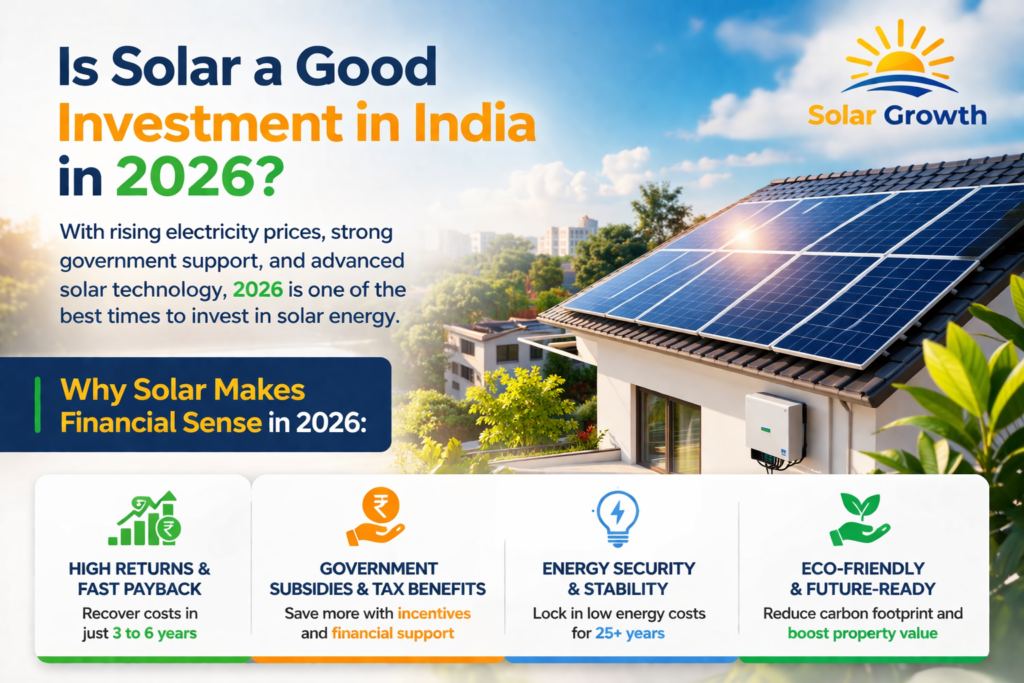
- Payback period ranging between 3 to 6 years depending on usage
- Lifespan of 25 years or more
- Substantial savings on monthly electricity bills
- Protection against tariff hikes
Once the system recovers its cost, the electricity generated is essentially free, making it a high-yield, low-risk investment over time.
Technological Advancements Improve Efficiency
Solar technology has evolved rapidly, making systems more efficient, durable, and accessible.
Modern systems offer:
- Higher energy output with fewer panels
- Better performance in low-light conditions
- Smart monitoring systems for real-time tracking
- Improved battery storage solutions for energy independence
These advancements enhance both reliability and overall returns.
Ideal for Both Residential and Commercial Use
Whether you are a homeowner looking to cut electricity bills or a business aiming to reduce operational costs, solar adapts seamlessly.
For homeowners:
- Reduced monthly expenses
- Increased property value
- Energy independence
For businesses:
- Lower operating costs
- Improved sustainability profile
- Competitive advantage in a green-conscious market
Environmental and Strategic Value
Beyond financial returns, solar investment contributes to sustainability goals. With increasing emphasis on ESG and environmental responsibility, adopting solar positions individuals and businesses as forward-thinking and responsible.
It also reduces reliance on conventional energy sources, ensuring long-term energy security.
Factors to Consider Before Investing
While solar is highly rewarding, thoughtful planning is essential.
Consider:
- Roof space and sunlight availability
- Initial investment and financing options
- Type of system and energy requirements
- Local policies and net metering regulations
A well-designed system tailored to your consumption patterns ensures maximum efficiency and returns.
Make an Informed Move Toward Solar
Solar in 2026 is not just a trend. It is a strategic investment that combines financial savings, energy security, and environmental responsibility. With the right system and guidance, the benefits can be substantial and long-lasting.
If you are considering switching to solar and want clarity on costs, savings, and system suitability, explore your options with a quick solar savings assessment and understand what solar could deliver for you.
FAQs
Is solar really profitable in India in 2026?
Yes, with rising electricity costs and government support, solar offers strong financial returns and long-term savings.
How long does it take to recover the investment?
Most systems achieve payback within 3 to 6 years, depending on usage and system size.
Does solar work during cloudy or rainy days?
Yes, solar panels still generate electricity in diffused sunlight, though at slightly reduced efficiency.
Is maintenance expensive?
No, solar systems require minimal maintenance, mainly periodic cleaning and basic inspections.
Can businesses benefit more from solar than homes?
In many cases, yes. Businesses with higher energy consumption often see faster returns and greater overall savings.
Investing in solar today is a step toward financial resilience and sustainable growth, making it one of the most practical decisions for the future.