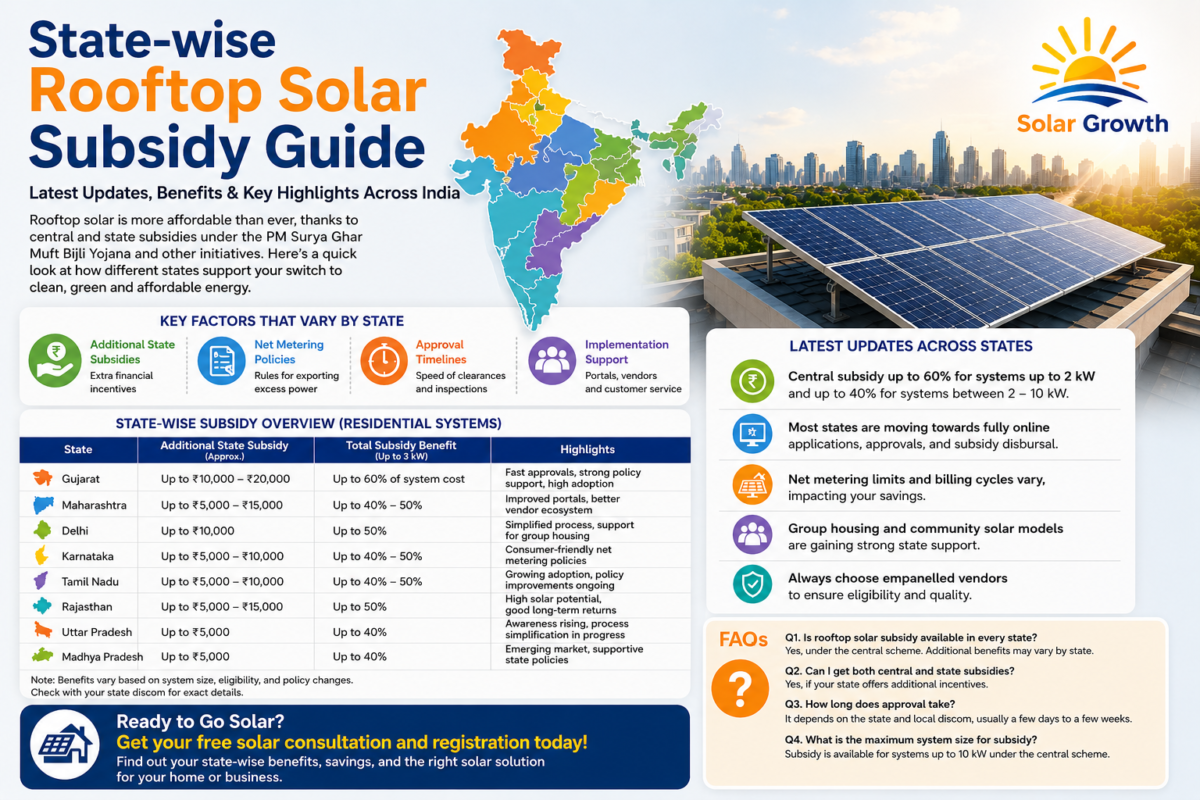
India’s rooftop solar sector is growing rapidly, but one policy continues to influence savings more than anything else, net metering. While solar subsidies help reduce installation costs, net metering determines how much value consumers receive from the electricity their systems generate over time. Across India, every state has its own approach to net metering, making it important for homeowners and businesses to understand how the rules differ before investing in rooftop solar.
Net metering is a billing mechanism that allows solar users to export excess electricity to the power grid. In return, they receive credits that reduce their monthly electricity bill. During the daytime, when solar generation is high, extra power is sent to the grid. At night or during low sunlight hours, consumers draw electricity back from the grid. The final bill reflects the net difference between electricity consumed and exported.
The central government, through Ministry of New and Renewable Energy and related regulatory authorities, has encouraged states to adopt consumer friendly net metering policies. However, implementation varies significantly across regions.
Gujarat remains one of the strongest states for rooftop solar and net metering. The state has streamlined approval systems and relatively stable policies, which have helped boost residential solar adoption. Consumers generally benefit from faster meter installation and smoother processing compared to many other states. Gujarat’s proactive electricity distribution companies have played a major role in supporting rooftop solar growth.
Maharashtra has also expanded rooftop solar adoption, particularly in urban areas such as Mumbai and Pune. The state allows net metering for residential and commercial systems, though approval timelines can sometimes vary depending on the local electricity provider. Recent digitization efforts have improved transparency and reduced paperwork, making the process more consumer friendly.
Delhi’s net metering framework has become increasingly important because of rising electricity demand and limited rooftop space. Shared solar systems and group housing projects are gaining popularity in the capital. Residents living in apartments can now participate more easily through community based solar models, which are being encouraged through updated regulations.
Karnataka continues to be viewed as one of the more balanced solar markets in southern India. The state has historically maintained supportive net metering structures and reliable implementation processes. Consumers benefit from predictable billing adjustments and relatively efficient approvals.
Tamil Nadu, despite having a strong renewable energy base, has experienced periodic policy changes regarding rooftop solar and billing structures. However, the state remains committed to expanding clean energy adoption, and residential solar interest continues to rise steadily.
Rajasthan benefits greatly from high solar radiation levels, making rooftop solar highly effective for long term savings. Net metering in the state supports residential and commercial users, especially in cities where electricity consumption during summer months is high.
States such as Uttar Pradesh, Madhya Pradesh, Telangana, and Andhra Pradesh are also strengthening their rooftop solar frameworks. While these markets are still developing compared to Gujarat or Karnataka, policy improvements and growing awareness are helping adoption accelerate.
One major difference across states is the system size limit allowed under net metering. Some states permit larger commercial installations, while others focus primarily on residential systems. Billing cycles, compensation structures, and settlement methods also vary. In some regions, excess electricity credits can be carried forward for months, while others settle balances annually.
Another growing trend is the shift toward smart meters and digital monitoring systems. States are increasingly encouraging advanced metering infrastructure to improve transparency and reduce disputes related to exported electricity. These systems provide real time tracking of solar generation and consumption, helping consumers better understand their savings.
Industry experts believe that net metering policies will continue evolving as rooftop solar penetration increases. Electricity distribution companies are trying to balance grid stability with consumer incentives. While occasional policy adjustments are expected, the overall direction across India remains strongly supportive of decentralized solar power.
For homeowners, net metering can significantly shorten the payback period of a rooftop solar system. In states with favorable regulations and smooth approvals, consumers can recover installation costs much faster through monthly electricity savings. Businesses with high daytime energy usage can benefit even more because solar generation aligns closely with operating hours.
As rooftop solar adoption grows, understanding state specific net metering policies has become just as important as understanding subsidies. The right policy environment can make a major difference in overall savings and system performance over the long term.
If you are planning to install rooftop solar, evaluating your state’s net metering rules can help you maximize returns and avoid unnecessary delays. You can begin by exploring the free registration to understand the best rooftop solar solution for your home or business.
FAQs
1. What is net metering in simple terms
Net metering allows solar users to send excess electricity to the grid and receive bill credits in return.
2. Is net metering available in every Indian state
Most Indian states support net metering, although the rules and benefits vary by region.
3. Which states have the best net metering policies
Gujarat and Karnataka are often considered among the strongest states due to smoother implementation and supportive regulations.
4. Can commercial buildings use net metering
Yes, many states allow commercial and industrial properties to use net metering within approved capacity limits.
5. Do net metering rules change frequently
Policies can be updated periodically by state regulators, so it is important to check the latest local guidelines before installation.
6. Why is net metering important for rooftop solar
It improves financial savings by allowing consumers to offset electricity costs using excess solar power generation.