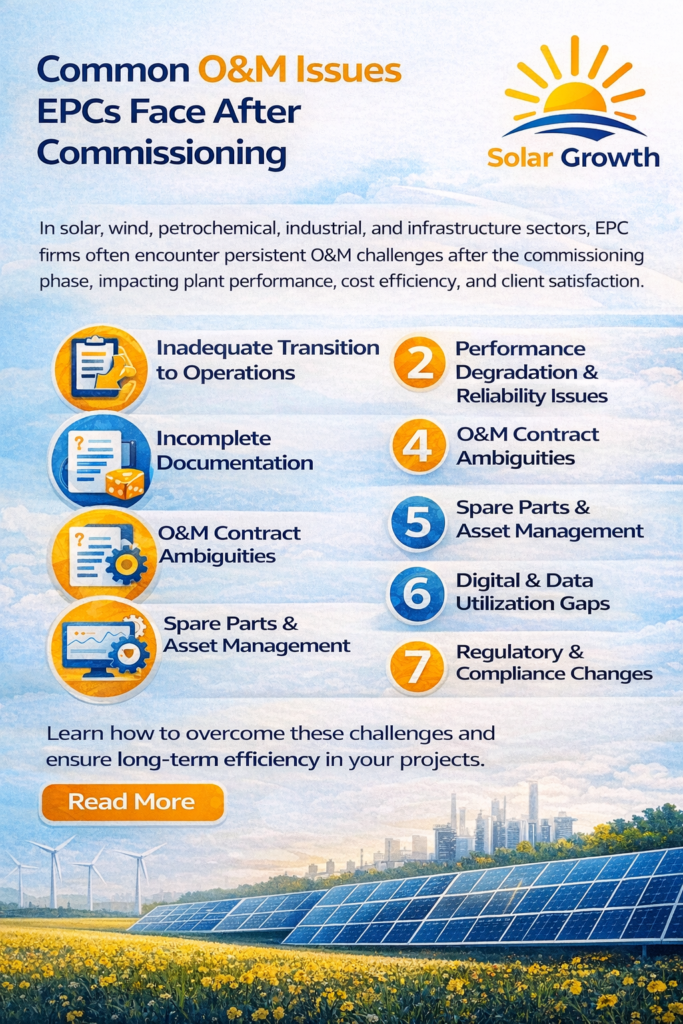
In today’s complex project delivery environment across solar, wind, petrochemical, industrial, and infrastructure sectors, the transition from construction to long term operation is one of the most critical phases of an EPC project lifecycle. Even when commissioning is technically successful, many EPC contractors encounter persistent Operations and Maintenance challenges that affect plant performance, cost efficiency, and overall client satisfaction.
In 2025 and 2026, as projects become more digitized and performance driven, these issues have become even more visible.
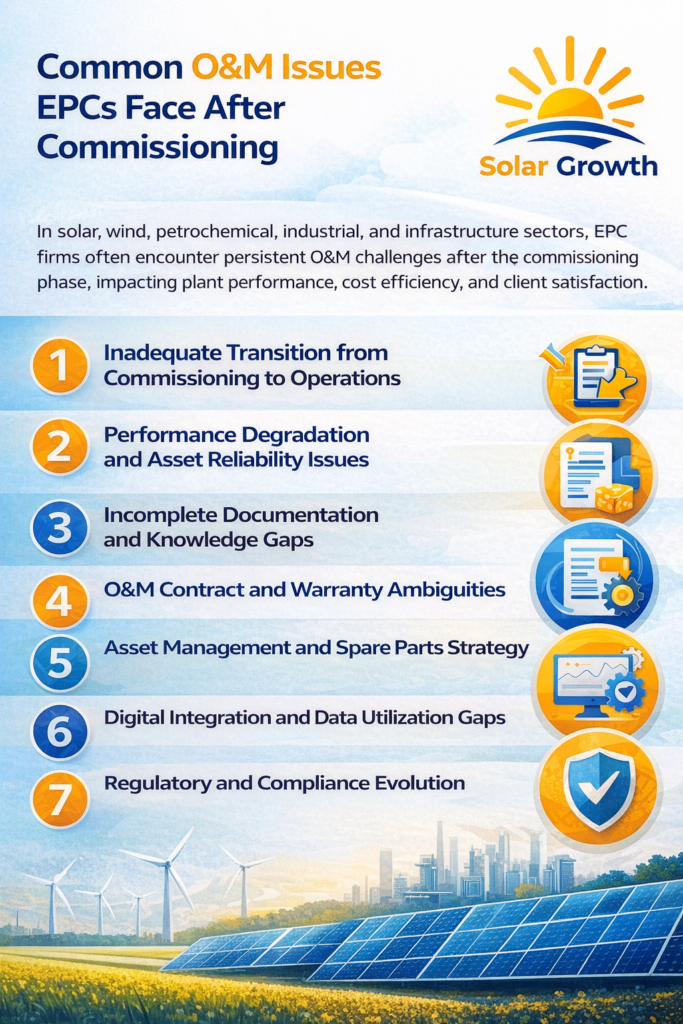
1. Inadequate Transition from Commissioning to Operations
One of the most common post commissioning challenges is an ineffective handover process. EPC teams are often focused on meeting project deadlines and achieving commissioning milestones. However, the depth of knowledge transfer required for seamless operations is sometimes underestimated.Operations and maintenance teams may not be sufficiently involved during commissioning tests, control system familiarization, and troubleshooting exercises. As a result, once the EPC team exits, operators may struggle with system nuances, unresolved punch points, or undocumented adjustments. This leads to operational inefficiencies and unnecessary downtime during the early months of plant operation.Early integration of O&M teams during commissioning significantly reduces this risk and ensures operational continuity.
2. Performance Degradation and Asset Reliability Issues
Systems may pass initial performance tests, but real world operating conditions often reveal weaknesses that were not evident during commissioning. In the first year of operation, common issues include:
. Accelerated wear due to incomplete calibration or alignment.
. Control systems that are not fully optimized for fluctuating loads or environmental variations.
Components such as connectors, cabling, seals, and mechanical fittings failing earlier than expected.
In renewable energy projects, especially solar and wind, factors such as dust accumulation, temperature stress, humidity, and grid instability can reduce energy yield if proactive monitoring is not implemented. Even minor inefficiencies can compound into significant financial losses over time.
3. Incomplete Documentation and Knowledge Gaps
Documentation remains a persistent concern. In many projects, the final handover package lacks fully updated as built drawings, detailed control logic documentation, and comprehensive maintenance manuals.
When O&M teams do not have access to accurate documentation, they are forced to rely on assumptions or reverse engineer system configurations. This increases maintenance time, delays troubleshooting, and elevates the risk of operational errors. Proper documentation is not merely administrative compliance. It is fundamental to long term asset reliability.
4. O&M Contract and Warranty Ambiguities
Post commissioning service arrangements frequently create friction between EPC contractors and asset owners. Warranty clauses may not clearly define the boundary between EPC responsibility and owner responsibility. In some cases, O&M services are subcontracted without strong performance accountability structures.
As warranty periods expire, clients may renegotiate service terms, sometimes resulting in service gaps or disputes over performance benchmarks. These contractual ambiguities can lead to unexpected operating costs and strained relationships. Clear service level agreements and measurable performance indicators are essential to avoid such complications.
5. Asset Management and Spare Parts Strategy
A structured spare parts strategy is often overlooked during project execution. Once the plant is operational, delays in sourcing critical components can result in extended downtime.
Many projects face challenges such as:
. Long lead times from original equipment manufacturers.
. Inadequate onsite inventory of critical spares.
. Poor visibility into component lifecycle expectations.
Without predictive asset management practices, maintenance becomes reactive rather than preventive. This not only affects reliability but also reduces overall asset value.
6. Digital Integration and Data Utilization Gaps
Modern O&M relies heavily on data driven insights. However, not all projects are equipped with integrated digital ecosystems. Gaps often include:
. Lack of centralized performance dashboards.
. Limited predictive maintenance capabilities.
. Poor integration between SCADA systems and maintenance workflows.
When data is fragmented or underutilized, emerging faults go unnoticed until they escalate. In 2025 and 2026, as performance guarantees tighten and financing models become output linked, digital maturity is no longer optional. It is a competitive necessity.
7. Regulatory and Compliance Evolution
Regulatory frameworks continue to evolve, particularly in energy and heavy industry sectors. Post commissioning requirements may include enhanced reporting, emissions tracking, cybersecurity compliance, and updated safety protocols.
If compliance mechanisms are not embedded during the design and execution phase, EPC firms may face additional workload and unexpected costs during the operational phase. Forward planning and regulatory foresight are essential to mitigate these risks.
Frequently Asked Questions
Q1. What is the difference between commissioning and O&M?
Commissioning verifies that systems meet design specifications and operate safely under defined parameters. Operations and Maintenance focuses on sustaining performance, conducting preventive maintenance, and addressing corrective issues to ensure long term reliability and efficiency.
Q2. Why do EPC firms struggle with O&M despite successful commissioning?
EPC organizations are traditionally structured around engineering and construction excellence. O&M requires a different operational mindset that emphasizes lifecycle thinking, data analysis, preventive planning, and workforce training. The skill sets and performance metrics differ significantly.
Q3. How critical is the handover process?
The handover process is one of the strongest predictors of long term plant performance. Inadequate knowledge transfer, incomplete documentation, and limited operator training often lead to early stage operational instability.
Q4. Can digital technologies reduce post commissioning risks?
Yes. Real time monitoring, predictive analytics, condition based maintenance systems, and integrated reporting platforms significantly improve fault detection and reduce downtime. Digital integration enhances both reliability and financial performance.
Q5. What contractual elements help mitigate O&M disputes?
Clearly defined scope boundaries, measurable service level agreements, transparent warranty clauses, spare parts planning obligations, and accountability matrices reduce ambiguity and strengthen collaboration between EPC contractors and asset owners.
Q6. Are O&M challenges sector specific?
While certain technical challenges differ between solar, petrochemical, and industrial facilities, the core issues such as documentation gaps, transition weaknesses, contractual ambiguity, and digital underutilization are common across sectors.
Conclusion
EPC firms can no longer view commissioning as the finish line. Sustainable project success depends on operational readiness, digital integration, contractual clarity, and lifecycle planning. By embedding O&M considerations from the design stage through commissioning, contractors can significantly reduce operational disruptions and strengthen long term client relationships.