Introduction
Commercial solar installations are often promoted as a straightforward path to lower electricity costs and long-term energy stability. Businesses are attracted by strong ROI projections, predictable energy pricing, and sustainability benefits.
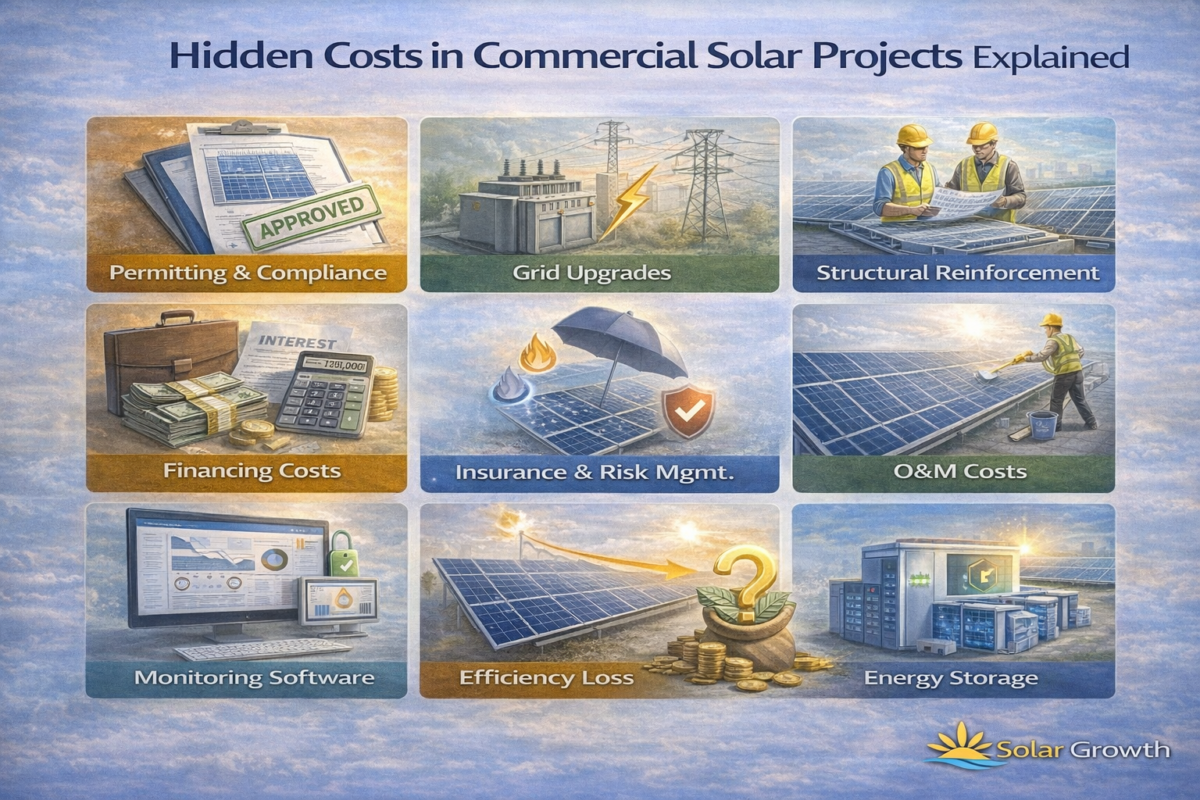
However, the advertised price of a solar system rarely represents the total project cost. Many companies only consider the engineering, procurement, and construction (EPC) price quoted by installers. In reality, commercial solar projects involve several hidden costs that can affect project profitability and payback timelines.
These costs are not necessarily hidden intentionally. They are often overlooked during early feasibility discussions or underestimated during financial modelling.
This guide explains the most common hidden costs in commercial solar projects globally, how they arise, and how businesses can account for them when evaluating solar investments.
Understanding the True Cost of Commercial Solar Projects
A typical commercial solar project includes multiple cost components beyond panel installation.
Core Cost Categories
- Solar modules and inverters
- Mounting structures and electrical equipment
- Installation and EPC services
- Grid connection and infrastructure
- Financing and operational expenses
The EPC quote usually covers only part of the project lifecycle.
Ignoring additional expenses can lead to inaccurate ROI expectations.
1. Permitting and Regulatory Compliance Costs
Commercial solar projects must comply with local regulations, safety codes, and grid requirements.
Typical Expenses
- Building permits
- Environmental approvals
- Electrical inspections
- Utility interconnection fees
- Legal and documentation costs
In many countries, permitting costs can range from 2–5% of total project value.
Real Scenario
A warehouse solar project planned at $1.2 million required additional structural certifications and fire compliance approvals. These regulatory requirements added nearly $50,000 to the project budget.
Proper regulatory planning is essential for accurate project cost estimation.
2. Grid Interconnection and Infrastructure Upgrades
Connecting a solar plant to the electricity grid may require infrastructure upgrades.
Potential Costs
- Transformer upgrades
- Switchgear installations
- Transmission line reinforcement
- Utility interconnection studies
These upgrades are often identified only after detailed grid studies.
Example
A commercial facility planning a 2 MW rooftop solar plant discovered that the existing transformer capacity was insufficient. The upgrade required an additional $120,000 investment.
Grid compatibility assessments should be conducted early in project planning.
3. Structural Reinforcement for Rooftop Systems
Many commercial rooftops were not originally designed to support solar panels.
Before installation, engineers must evaluate structural load capacity.
Additional Costs May Include
- Roof reinforcement
- Structural steel supports
- Waterproofing improvements
- Wind resistance modifications
Structural adjustments may increase project cost by 3–10% depending on building condition.
Ignoring structural limitations can lead to safety risks and project delays.
4. Financing and Interest Costs
Solar projects often rely on external financing such as bank loans or leasing arrangements.
Financing introduces additional expenses beyond equipment cost.
Financial Cost Factors
- Loan interest payments
- Debt servicing charges
- Bank processing fees
- Financial advisory fees
Over a 15-year loan period, interest payments can add 20–30% to the effective project cost.
Businesses evaluating solar investments should consider lifetime financing expenses, not just upfront capital costs.
5. Operation and Maintenance (O&M) Costs
Solar systems require ongoing maintenance to maintain optimal performance.
Typical O&M Activities
- Panel cleaning
- Inverter servicing
- Performance monitoring
- Preventive inspections
- Spare part replacements
Annual maintenance costs typically range between 1–2% of system cost per year.
Failure to maintain systems properly can reduce energy generation and extend payback periods.
6. Insurance and Risk Management
Commercial solar assets require insurance coverage to protect against unexpected events.
Common Insurance Types
- Property insurance
- Equipment breakdown insurance
- Business interruption coverage
- Natural disaster protection
Insurance premiums vary by region but typically account for 0.5–1% of system cost annually.
These expenses must be included in long-term project financial models.
7. Performance Degradation and Efficiency Loss
Solar panels gradually lose efficiency over time.
Most modules degrade at a rate of approximately 0.5–0.7% per year.
Impact on Financial Projections
Lower energy generation reduces long-term revenue or savings.
For example:
A 1 MW system producing 1.6 million kWh annually may generate 10–12% less electricity after 20 years.
Accurate financial models account for performance degradation when estimating ROI.
8. Monitoring Software and Data Management
Modern commercial solar plants use monitoring platforms to track performance and detect faults.
Typical Monitoring Expenses
- SCADA systems
- Cloud-based monitoring platforms
- Data analytics software
- Cybersecurity protection
While these systems improve operational efficiency, they add additional capital and subscription costs.
9. Energy Storage Integration (Optional but Growing)
Many businesses consider adding battery storage to improve energy management.
Storage Costs Include
- Battery system purchase
- Battery management systems
- Additional power electronics
- Replacement costs over time
Battery systems can significantly increase project cost but provide grid resilience and peak demand management benefits.
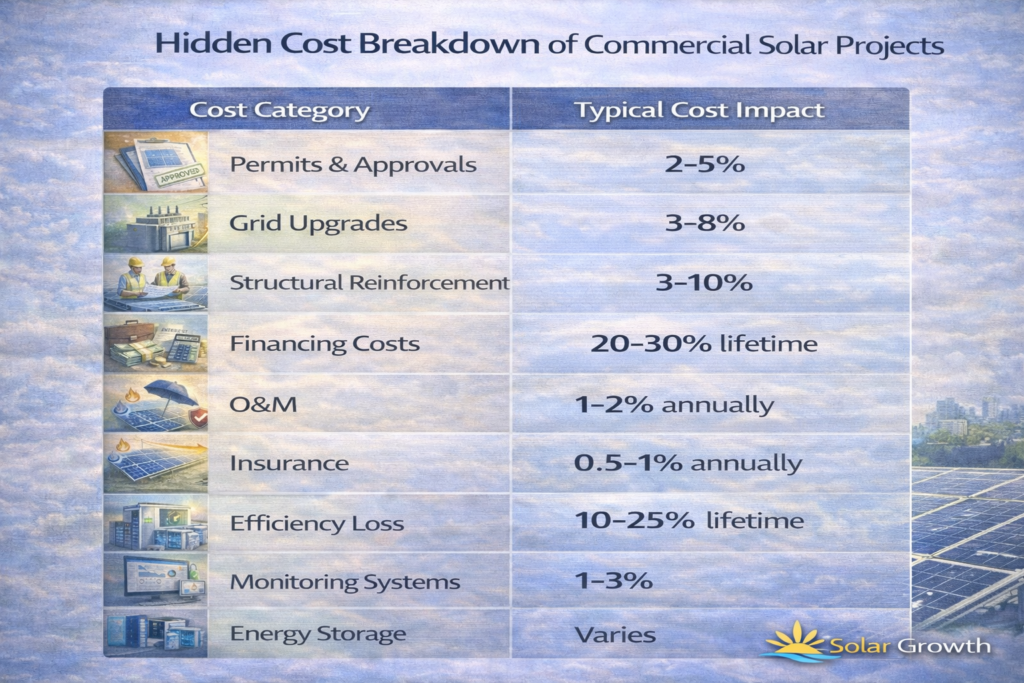
Hidden Cost Summary Table
| Cost Category | Typical Impact |
| Permits & approvals | 2–5% |
| Grid upgrades | 3–8% |
| Structural reinforcement | 3–10% |
| Financing costs | 20–30% lifetime |
| O&M costs | 1–2% annually |
| Insurance | 0.5–1% annually |
| Monitoring systems | 1–3% |
Understanding these costs helps businesses create realistic project budgets.
Common Mistakes Businesses Make
Many organizations underestimate project complexity when evaluating solar investments.
Common mistakes include:
- Evaluating solar projects only based on EPC price
- Ignoring financing and operational expenses
- Underestimating permitting timelines
- Not conducting grid feasibility studies
- Overestimating energy generation
These mistakes can significantly affect project returns.
Best Practices for Accurate Solar Project Budgeting
To avoid hidden cost surprises, businesses should follow industry best practices.
Conduct Detailed Feasibility Studies
Evaluate site conditions, structural capacity, and grid compatibility early.
Include Lifecycle Cost Analysis
Consider capital cost, financing, maintenance, and operational expenses over the full project life.
Work with Experienced EPC Providers
Experienced developers can identify potential hidden costs during project planning.
Perform Sensitivity Analysis
Model different scenarios such as energy price changes and system degradation.
Global Industry Trends
Commercial solar adoption continues to accelerate worldwide.
Businesses adopt solar for multiple reasons:
- Long-term electricity cost stability
- Sustainability commitments
- Carbon reduction targets
- Energy security
However, sophisticated financial modelling is now standard practice for large solar investments.
Companies increasingly evaluate levelized cost of energy (LCOE) instead of only installation cost.
Conclusion
Commercial solar projects offer substantial financial and environmental benefits. However, the real cost of a solar system extends beyond equipment and installation.
Permitting, grid upgrades, financing, maintenance, insurance, and performance degradation all contribute to the total lifecycle cost of solar investments.
Businesses that account for these hidden costs early in project planning can make better investment decisions and avoid unexpected financial surprises.
With proper planning and realistic financial modelling, commercial solar projects remain one of the most effective strategies for long-term energy cost management.
FAQs
1. What are the most common hidden costs in commercial solar projects?
Common hidden costs include permitting fees, grid upgrades, structural modifications, financing expenses, insurance, and ongoing maintenance.
2. Do hidden costs significantly affect solar ROI?
Yes. If not accounted for properly, hidden costs can extend the payback period and reduce overall project profitability.
3. How can businesses estimate the true cost of a solar project?
Companies should perform lifecycle cost analysis including installation, financing, maintenance, and operational expenses.
4. Are these hidden costs the same in every country?
No. Regulatory fees, grid interconnection costs, and financing structures vary widely between countries.
Written by Rohith Bingi
Solar Industry Analyst at Solar Growth, covering India’s solar value chain, policy landscape, and business growth trends