As solar adoption accelerates across rooftops and industrial parks, a quieter conversation is shaping investment decisions behind the scenes. Beyond panels and inverters, financial metrics like Internal Rate of Return (IRR) and Return on Investment (ROI) are emerging as the real decision makers, guiding businesses and homeowners toward smarter and more strategic solar investments.
In a market where electricity tariffs continue to rise and sustainability goals are gaining urgency, understanding these two indicators is no longer optional. It is essential.
The Rise of Financial Thinking in Solar
India’s solar sector has moved beyond early adoption. What was once an environmentally driven choice is now increasingly evaluated through a financial lens. Investors, CFOs, and even residential buyers are asking a fundamental question:
“Does this investment outperform other uses of my capital?”
That is where ROI and IRR come into play.
ROI: The First Layer of Profitability
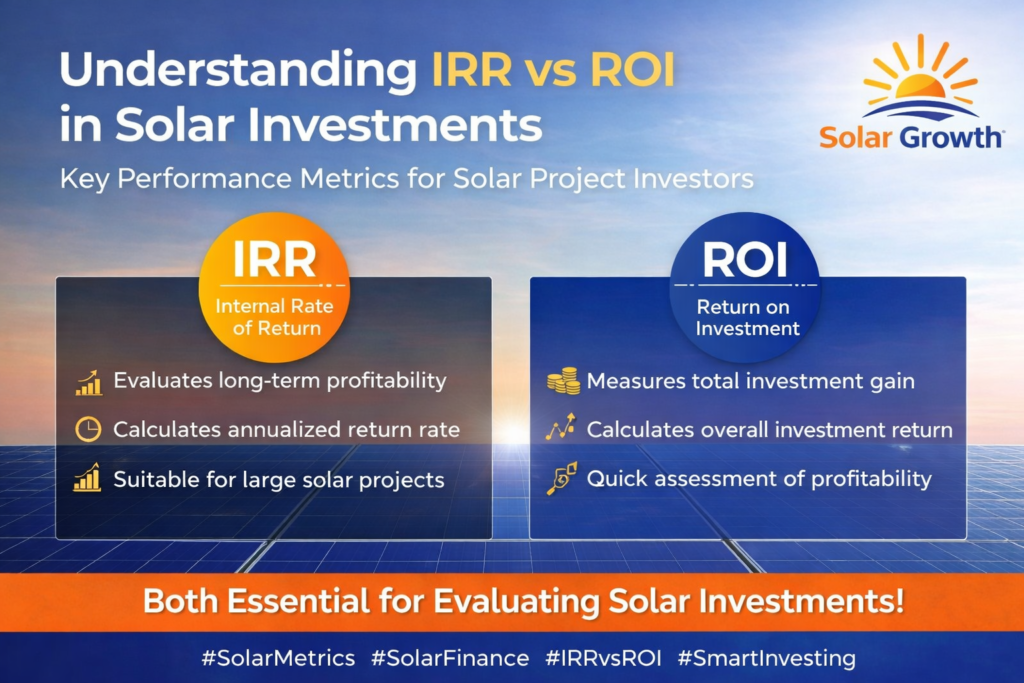
Return on Investment, or ROI, remains the most widely understood metric. It provides a simple snapshot of profitability by comparing total gains against the initial investment.
In solar terms, ROI answers a direct question:
How much money will I make over the system’s lifetime?
For instance, a commercial solar installation costing $50,000 that generates $90,000 in electricity savings over 20 years yields a strong positive return. The appeal of ROI lies in its clarity. It quickly signals whether a project is financially viable.
However, industry experts caution that ROI tells only part of the story.
IRR: The Metric That Changes the Conversation
Internal Rate of Return, or IRR, adds a critical dimension. Time.
Unlike ROI, IRR measures the annualized return of a solar investment, taking into account when savings occur over the system’s lifespan. This transforms the evaluation from a static snapshot into a dynamic financial analysis.
A solar project with a 13 percent IRR, for example, effectively delivers a 13 percent yearly return. This often outperforms traditional instruments like fixed deposits or low risk bonds.
As a result, IRR has become the preferred benchmark for comparing solar with other investment opportunities.
Why IRR is Gaining Ground
The growing reliance on IRR reflects a broader shift in how solar is perceived. It is no longer just an energy solution. It is a financial asset.
Several factors contribute to this shift:
- Predictable cash flows
Solar systems generate consistent savings, making future returns relatively stable and forecastable - Long term performance
With lifespans exceeding 25 years, solar installations provide extended earning potential - Minimal operating costs
Maintenance expenses are typically low, preserving margins over time - Policy support
Mechanisms such as net metering and government incentives further enhance returns, improving both ROI and IRR figures
A Tale of Two Projects
Consider two solar investments:
- Project A offers a higher total return over 20 years
- Project B delivers slightly lower overall gains but achieves them faster
While ROI might favor Project A, IRR could reveal that Project B generates superior annual returns. This makes it the more efficient use of capital.
This distinction is increasingly influencing procurement decisions, particularly among commercial and industrial users.
What Defines a Strong Solar Investment
Market observations suggest that:
- Commercial solar projects often achieve 10 percent to 18 percent IRR
- Residential systems typically range between 8 percent to 14 percent IRR
These figures, combined with relatively low risk, position solar as a compelling alternative to conventional investments.
The Subtle Risks Behind the Numbers
Despite their usefulness, both metrics depend heavily on accurate assumptions.
Experts warn against common pitfalls such as:
- Overestimating electricity price escalation
- Ignoring panel degradation over time
- Underestimating maintenance and system downtime
A well structured proposal should transparently account for these variables to ensure realistic projections.
The Bigger Picture
As India moves toward ambitious renewable energy targets, solar investments are increasingly being evaluated with the same rigor as financial portfolios. IRR and ROI are no longer just technical terms in a proposal. They are central to decision making.
For businesses, they determine capital allocation.
For homeowners, they shape long term savings.
For the industry, they signal maturity.
For those looking to evaluate their own solar potential and returns more clearly, you can explore a tailored assessment through this free registration page. It is a starting point for understanding what these numbers could look like in your specific case.
Frequently Asked Questions
What is more important for solar projects IRR or ROI
Both matter, but IRR is generally more useful for comparing solar with other investments because it accounts for time.
Can a project have high ROI but low IRR
Yes. If returns take longer to materialize, ROI can look attractive while IRR remains modest.
Is solar a safe investment
Compared to many alternatives, solar is considered relatively low risk due to predictable savings and long asset life.
Do incentives significantly impact returns
Yes, subsidies and net metering policies can substantially improve both IRR and ROI.