Introduction
Electricity costs are one of the largest operational expenses for businesses in India. Manufacturing plants, IT parks, malls, and large commercial facilities consume significant amounts of power daily. Rising tariffs and fluctuating fuel costs make electricity budgeting difficult for many companies.
To reduce dependence on expensive grid electricity, many businesses are adopting open access solar power. This model allows companies to buy renewable electricity directly from solar power plants located outside their premises.
Open access solar has become a popular solution for large power consumers because it offers lower tariffs, long-term price stability, and sustainability benefits.
This guide explains how open access solar works in India, the regulatory framework, cost benefits, and whether it is the right option for your business.
What Is Open Access Solar?
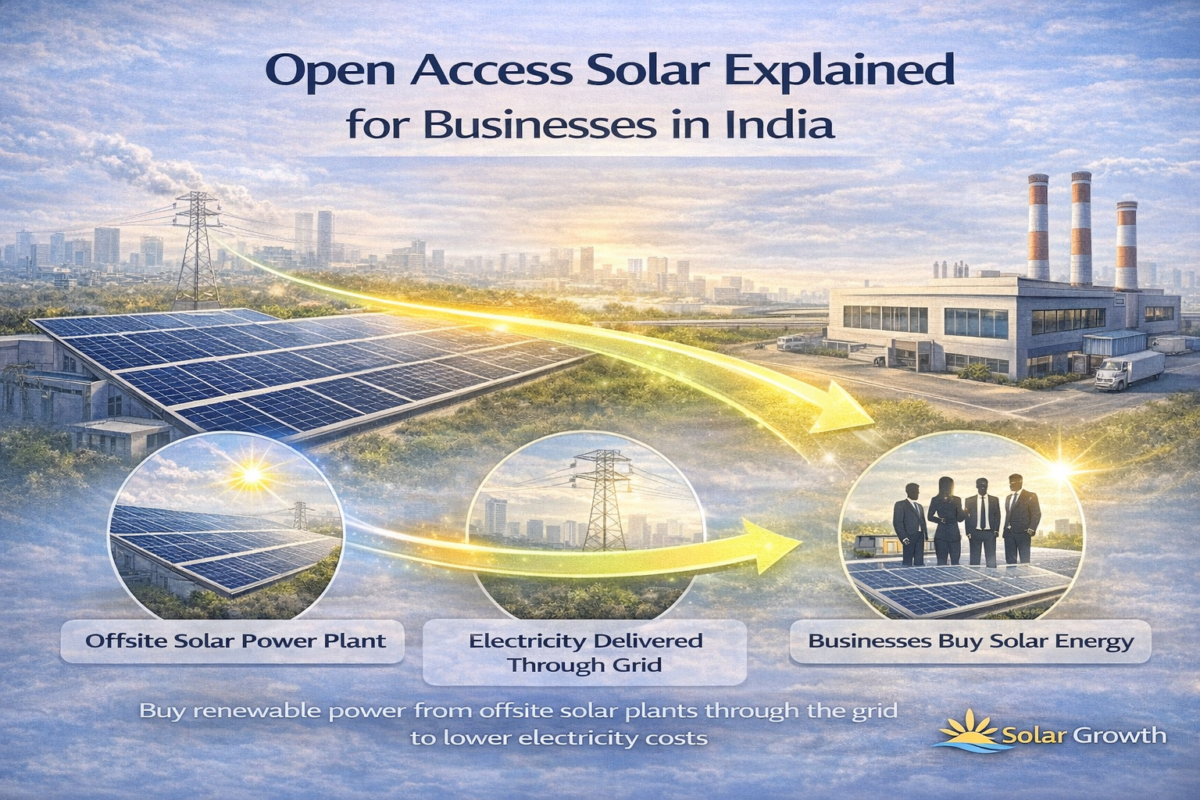
Open access solar allows electricity consumers to purchase renewable energy from a solar power plant through the transmission and distribution network.
Instead of installing solar panels on their own rooftops, businesses can source solar power from an offsite plant.
Key Characteristics
- Power generated at a remote solar plant
- Electricity delivered via grid infrastructure
- Businesses sign long-term power purchase agreements (PPAs)
- Lower electricity cost compared to grid tariffs
This model enables companies without large rooftop space to access solar power.
How Open Access Solar Works
The open access solar model involves several participants.
Key Stakeholders
- Solar power developer
- Electricity consumer (business)
- Transmission utility
- State DISCOM
- Regulatory authorities
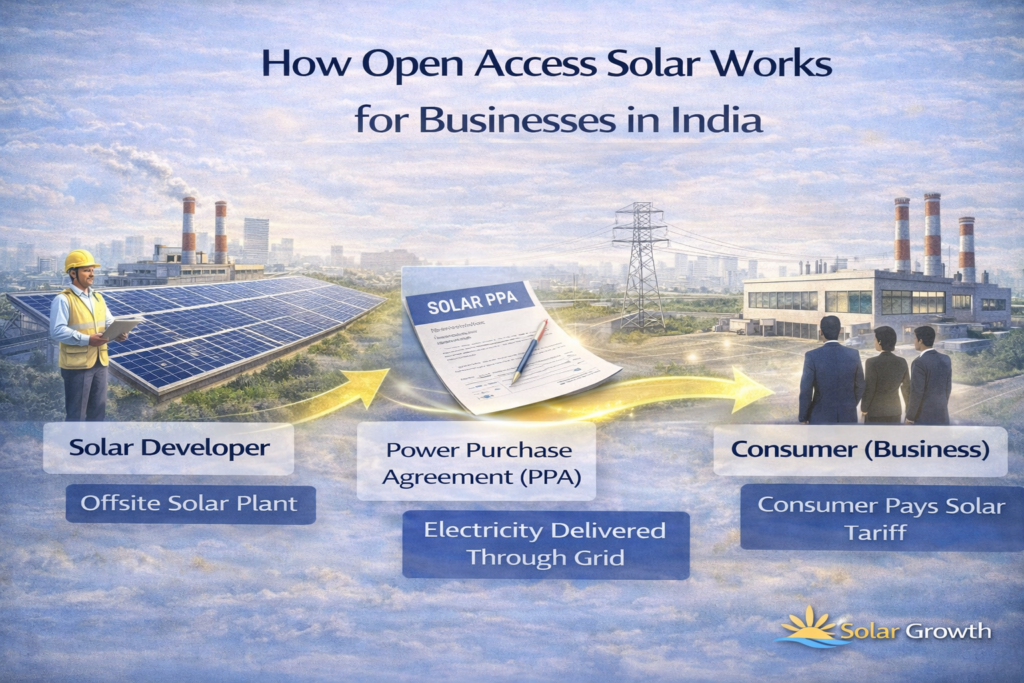
Basic Process
- Solar developer builds a solar plant
- Business signs a power purchase agreement (PPA)
- Electricity is transmitted through open access network
- Consumer pays solar tariff instead of grid tariff
This structure allows businesses to purchase renewable energy even if the plant is located hundreds of kilometers away.
Types of Open Access Solar Models
Businesses can access solar power through different procurement structures.
1. Captive Solar
A company owns at least 26% equity in the solar plant and consumes electricity generated.
Advantages:
- Lower tariffs
- Long-term ownership benefits
- Regulatory exemptions in some states
2. Group Captive Solar
Multiple businesses jointly invest in a solar power plant.
Requirements include:
- Minimum 26% combined equity ownership
- Minimum 51% electricity consumption by investors
Group captive is a common open access structure for medium-sized companies.
3. Third-Party Open Access
In this model, the solar developer owns the plant completely.
Businesses purchase electricity through a long-term PPA.
Advantages:
- No capital investment
- Lower operational responsibility
However, tariffs may be slightly higher than captive models.
Electricity Cost Savings with Open Access Solar
One of the biggest benefits of open access solar is lower electricity tariffs.
Typical electricity cost comparison:
| Source | Cost per Unit |
| Grid electricity | ₹7 – ₹11 |
| Open access solar | ₹4 – ₹6 |
| Captive solar | ₹3 – ₹4 |
Businesses can reduce electricity costs by 30–50% depending on state policies and project structure.
Example: Industrial Open Access Solar Savings
A manufacturing company consumes 1.5 million units annually.
Grid tariff:
₹9 per unit
Annual Electricity Cost
₹1.35 crore
If the company signs an open access solar PPA at ₹4.8 per unit:
Annual electricity cost becomes:
₹72 lakh
Annual Savings
₹63 lakh
Over 20 years, savings can exceed ₹12 crore.
Eligibility for Open Access Solar in India
Open access solar is typically available for large power consumers.
Most states require a minimum contract demand of 1 MW.
However, some states allow open access for smaller loads under new green energy policies.
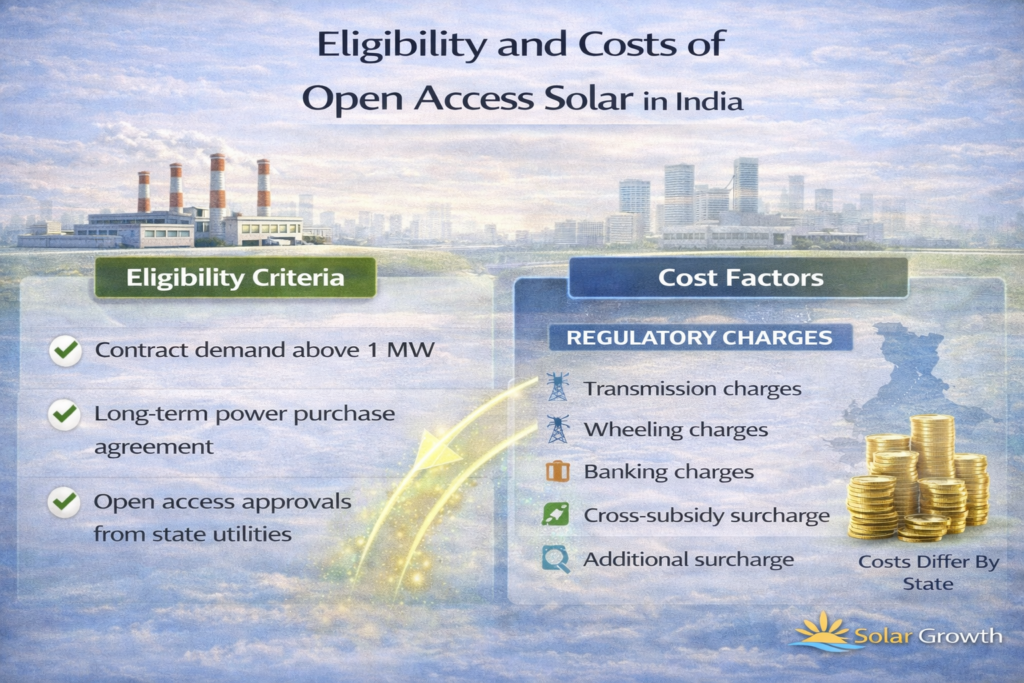
Typical Eligibility Criteria
- Contract demand above 1 MW
- Long-term power purchase agreement
- Open access approvals from state utilities
Eligibility rules vary across states.
Regulatory Charges in Open Access Solar
Businesses must consider several charges while calculating open access solar costs.
Common charges include:
- Transmission charges
- Wheeling charges
- Banking charges
- Cross-subsidy surcharge
- Additional surcharge
These charges differ by state and regulatory policy.
Even after these charges, solar tariffs remain significantly lower than grid electricity.
Benefits of Open Access Solar for Businesses
Open access solar provides multiple strategic advantages.
1. Lower Electricity Costs
Businesses can reduce power expenses significantly.
2. No Rooftop Space Requirement
Solar plants can be located offsite.
3. Long-Term Price Stability
Power purchase agreements typically last 15–25 years.
4. Sustainability Goals
Companies reduce carbon emissions and meet ESG commitments.
5. Scalability
Businesses can increase contracted capacity as demand grows.
Challenges Businesses Should Consider
Open access solar also involves certain challenges.
Policy Variability
Open access regulations differ between states.
Regulatory Approvals
Approval process can take several months.
Policy Changes
Charges or policies may change over time.
Companies should work with experienced solar developers to manage these risks.
Industries Adopting Open Access Solar
Open access solar adoption is growing across multiple sectors.
Common industries include:
- Automotive manufacturing
- Textile industries
- Cement plants
- Warehousing and logistics
- IT and data centers
These industries consume large amounts of electricity and benefit greatly from solar power procurement.
Common Mistakes Businesses Make
Many companies evaluating open access solar make avoidable mistakes.
Common errors include:
- Ignoring regulatory charges
- Not evaluating developer credibility
- Signing unclear PPA terms
- Overestimating electricity savings
Due diligence and financial modelling are essential.
Best Practices Before Adopting Open Access Solar
Businesses should follow a structured evaluation process.
Conduct Energy Audit
Understand energy consumption patterns.
Compare Procurement Models
Evaluate rooftop, captive, group captive, and open access models.
Verify Developer Track Record
Choose experienced solar developers.
Review Regulatory Framework
Ensure compliance with state policies.
Industry Trend: Corporate Renewable Energy Procurement
Corporate renewable energy adoption is growing rapidly in India.
Large corporations are signing long-term renewable PPAs to:
- Reduce electricity costs
- Meet sustainability targets
- Improve ESG reporting
Open access solar is expected to play a major role in India’s energy transition.
Conclusion
Open access solar has become one of the most effective ways for businesses in India to reduce electricity costs and access renewable energy.
By sourcing solar power from offsite plants through the grid network, companies can reduce electricity tariffs by up to 40% while achieving sustainability goals.
However, successful implementation requires careful evaluation of regulatory policies, contract structures, and developer credibility.
For large power consumers, open access solar is not just an environmental initiative it is a strategic energy procurement decision.
FAQs
1. What is open access solar in India?
Open access solar allows businesses to purchase renewable electricity from solar power plants through the grid instead of installing their own solar systems.
2. Who can use open access solar?
Typically businesses with electricity demand above 1 MW are eligible, although rules vary across states.
3. Is open access solar cheaper than grid electricity?
Yes. Businesses can reduce electricity costs by 30–50% depending on tariffs and regulatory charges.
4. What is the difference between open access and captive solar?
Open access refers to buying power through the grid, while captive solar involves ownership of the solar plant.
Written by Rohith Bingi
Solar Industry Analyst at Solar Growth, covering India’s solar value chain, policy landscape, and business growth trends