Introduction
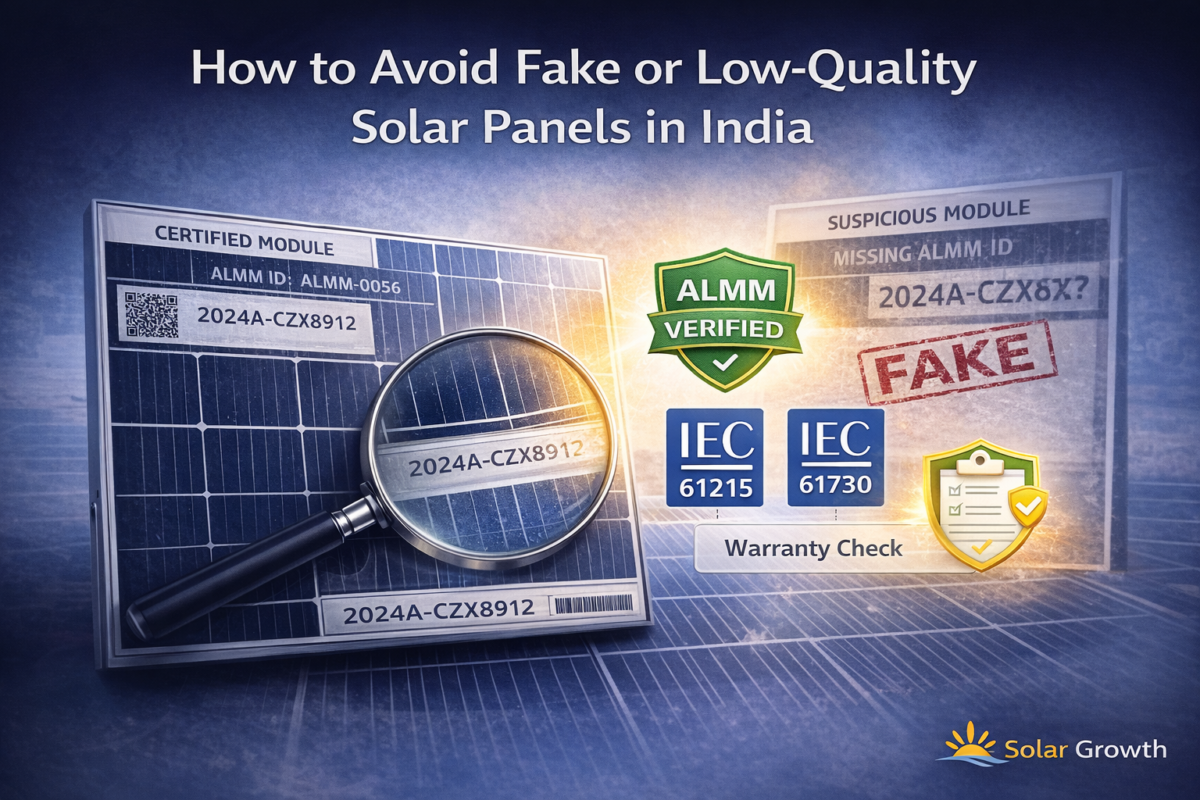
India’s solar market has grown rapidly. But with growth comes risk. Fake branding, substandard modules, relabeled imports, and poor-quality manufacturing are increasingly reported across residential and commercial segments.
For homeowners, EPC companies, and distributors, installing fake or low-quality solar panels is not just a financial mistake. It creates long-term performance loss, warranty disputes, and safety risks.
If you want to avoid fake solar panels in India, you need more than brand recognition. You need verification systems, documentation checks, and technical awareness.
This guide explains how to identify fake or low-quality solar panels in India using practical, industry-backed methods.
Why Fake or Low-Quality Solar Panels Are a Real Risk in India
Solar demand has increased due to:
- Government subsidies
- Net metering policies
- Rising electricity tariffs
- Corporate sustainability goals
Whenever demand rises quickly, low-quality supply enters the market.
Real-World Scenario
During high-demand phases, some dealers sold modules with:
- Fake flash test reports
- Altered wattage labels
- Unverified warranties
- Non-ALMM-listed models
Buyers discovered performance drops within 12–24 months.
Low-quality modules may look identical visually. The difference appears over time.
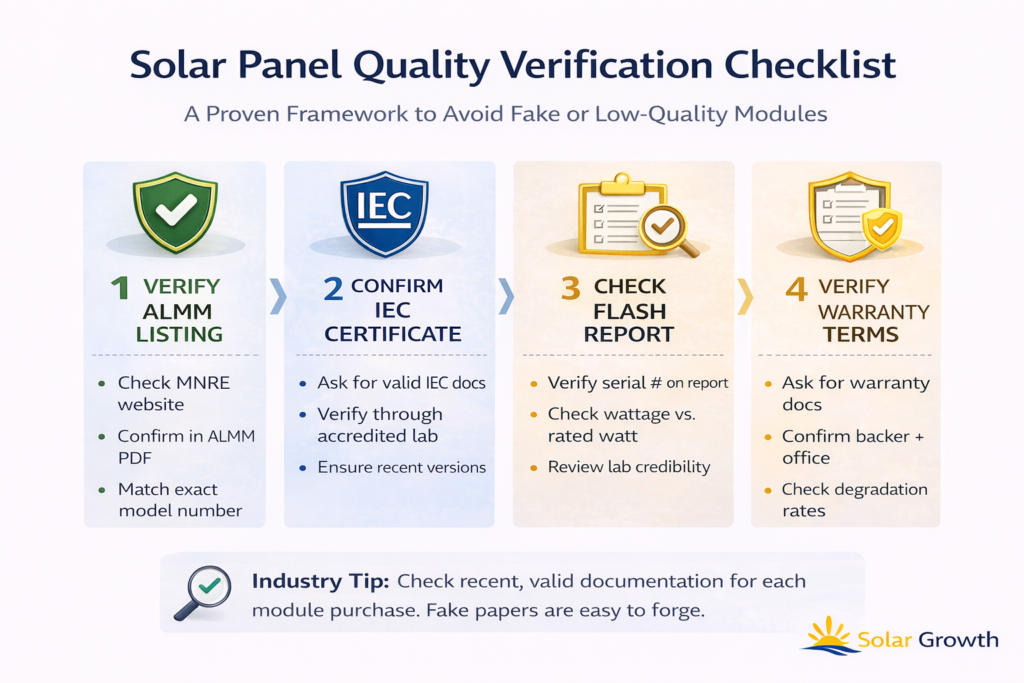
Step 1: Verify ALMM Listing (Mandatory for Many Projects)
The Approved List of Models and Manufacturers (ALMM) by MNRE is critical in India.
Why ALMM Matters
- Required for many government and DISCOM-linked projects
- Confirms manufacturer eligibility
- Reduces risk of counterfeit modules
How to Check
- Visit MNRE official website
- Search manufacturer name
- Verify exact module model number
Do not rely only on dealer claims.
If a module is not ALMM-listed when required, it may be ineligible for project approval.
Step 2: Check IEC Certification and Test Standards
Solar panel quality standards in India follow global IEC norms.
Key standards include:
- IEC 61215 (Performance & durability)
- IEC 61730 (Safety)
- IEC 62804 (PID resistance)
Ask for:
- Valid IEC certificates
- Recent test reports
- Accredited lab verification
Fake modules often present outdated or unverifiable documents.
Step 3: Inspect Flash Test Report Carefully
Every genuine module has an individual flash test report.
What to Check
- Serial number matching panel
- Measured wattage close to rated wattage
- Testing lab credibility
- QR code validation
Common fraud pattern: Reused flash reports across multiple modules.
Match the serial number physically printed on the panel.
Step 4: Verify Warranty Authenticity
Many low quality solar panels in India advertise 25–30 year warranties. But warranty means nothing without backing.
Questions to Ask
- Is the warranty backed by the manufacturer or dealer?
- Is there an Indian service office?
- What is a degradation guarantee? (e.g., 2% first year, 0.55% annually)
- Is product liability insurance included?
If warranty is unclear, it may not be enforceable.
Step 5: Inspect Physical Build Quality
You don’t need to be an engineer to inspect basic quality.
Visual Inspection Checklist
- Uniform cell alignment
- No micro-cracks
- Clean lamination edges
- Proper junction box sealing
- Anti-PID labeling
Cheap lamination and poor glass quality are early signs of degradation.
Step 6: Check Bill of Materials (BOM)
High-quality modules use:
- Tier-1 cells
- EVA with UV resistance
- High-transmission tempered glass
- Corrosion-resistant frame
If the supplier avoids sharing BOM details, that’s a red flag.
Step 7: Avoid Unverified Price Discounts
If a supplier offers:
- Price significantly below market
- Immediate availability during shortage
- No documentation delay
Be cautious.
Example
If the average 550Wp module price is ₹X/W and someone offers 10% lower without clear explanation, verify carefully.
Quality manufacturers rarely undercut drastically without reason.
Step 8: Buy from Reputable Channels
Choose:
- Authorized distributors
- Known EPC suppliers
- Direct manufacturer supply
Avoid:
- Informal traders
- Cash-only sellers
- No GST invoice transactions
Traceability reduces fraud risk.
Step 9: Understand Degradation and Performance Metrics
Fake or substandard modules often show:
- Higher degradation in first 2 years
- Hotspots
- Lower actual output
Typical Industry Benchmark
| Parameter | Industry Standard |
| First-year degradation | ≤2% |
| Annual degradation | 0.5–0.7% |
| Performance warranty | 25 years |
Anything significantly worse indicates risk.
Step 10: Use Third-Party Inspection for Large Orders
For EPCs or bulk distributors:
- Hire independent quality inspection agencies
- Conduct EL testing
- Verify pallet integrity
This is common industry practice in utility-scale projects.
Common Mistakes Buyers Make
- Trusting brand stickers without verification
- Ignoring serial number mismatch
- Over-prioritizing price
- Skipping documentation validation
- Buying from unknown traders during shortages
Most quality failures are avoidable.
How EPC Companies Protect Against Fake Modules
Professional EPC companies:
- Source from approved vendor lists
- Conduct random batch testing
- Cross-check ALMM listings
- Maintain quality audit documentation
This reduces project risk and warranty disputes.
If you’re an EPC or distributor, also read our guide on Inventory Management Tips for Solar Distributors in India to protect supply chain quality.
Why Avoiding Low-Quality Solar Panels Protects ROI
Low-quality modules can cause:
- Lower generation
- Client dissatisfaction
- Replacement costs
- Insurance disputes
- Brand damage
Solar is a 25-year asset. Quality decisions today affect performance for decades.
Conclusion
To avoid fake solar panels in India, you need structured verification — not assumptions.
Always verify:
- ALMM listing
- IEC certification
- Flash test authenticity
- Warranty backing
- Supplier credibility
Low-quality solar panels may reduce upfront cost but destroy long-term returns.
In India’s growing solar ecosystem, informed buyers protect their investment by prioritizing compliance, documentation, and quality over discounts.
FAQs
1. How can I check if a solar panel is genuine in India?
Verify ALMM listing, IEC certification, serial number match, and flash test report authenticity.
2. Are all imported solar panels fake?
No. Many imported modules are high quality. The key is certification and supplier verification.
3. What happens if I install non-ALMM panels?
For government-linked projects, they may become ineligible for subsidy or approval.
4. Can low-quality solar panels affect system performance?
Yes. Poor lamination, cell mismatch, and high degradation reduce output significantly over time.
Written by Rohith Bingi
Solar Industry Analyst at Solar Growth, covering India’s solar value chain, policy landscape, and business growth trends