Introduction
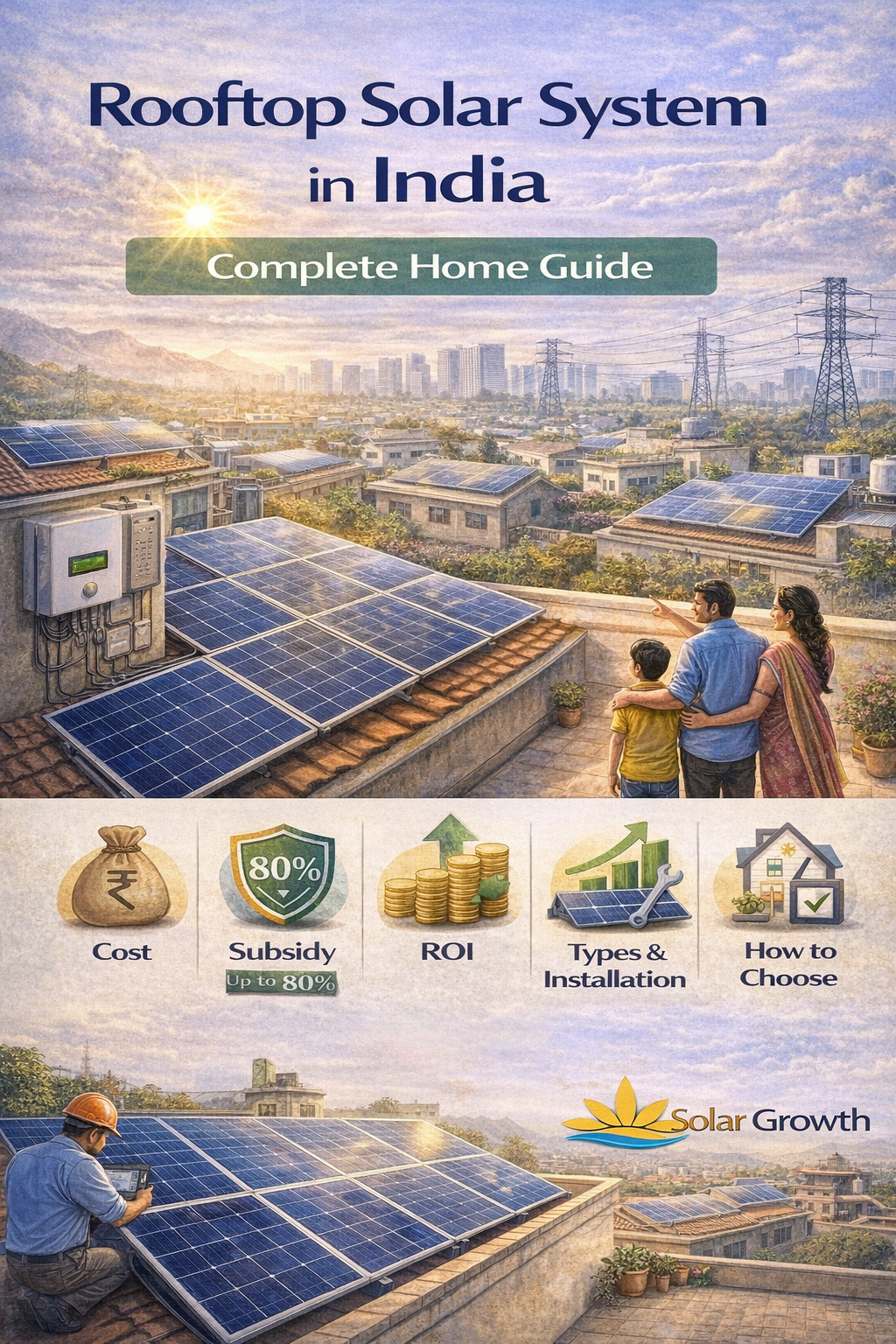
A rooftop solar system in India is one of the most effective ways to reduce electricity bills and generate long-term savings for homeowners.
Rooftop solar systems are no longer a niche concept in India. They are becoming a practical financial decision for homeowners looking to reduce electricity bills and gain long-term energy independence.
With rising electricity tariffs, government subsidies, and improved solar technology, more households are considering solar installations. But many people still make decisions based on incomplete or misleading information.
Solar is not just about installing panels it is about correct system design, financial planning, and execution.
This guide explains everything you need to know about rooftop solar systems in India, including types, cost, subsidy, ROI, maintenance, and real-world challenges.
What Is a Rooftop Solar System?
A rooftop solar system is a setup where solar panels are installed on the roof of a house to generate electricity using sunlight.
Key Components Explained
1. Solar Panels
Convert sunlight into electricity.
2. Inverter
Converts DC electricity into AC (usable in homes).
3. Mounting Structure
Supports panels on the rooftop.
4. Electrical System
Includes cables, junction boxes, protection systems.
5. Net Meter
Measures import/export of electricity.
How Rooftop Solar Works (Step-by-Step)
- Sunlight hits panels
- Panels generate DC power
- Inverter converts to AC
- Electricity powers your home
- Excess energy goes to grid
At night, electricity is drawn from the grid.
To understand billing impact, refer to Net Metering Explained for Homeowners in India .
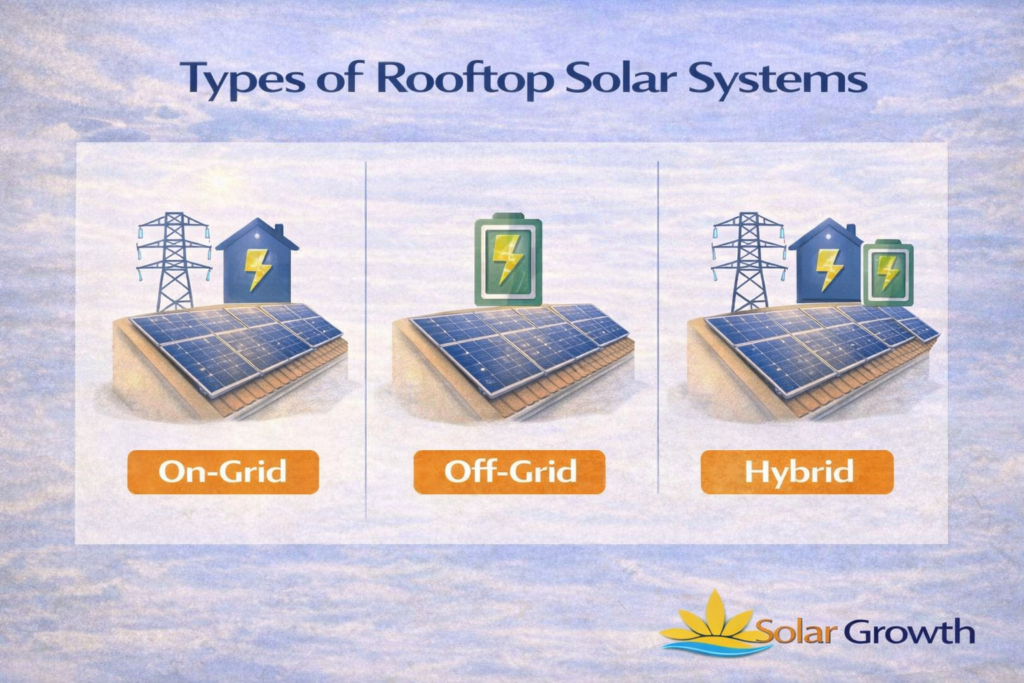
Types of Rooftop Solar Systems
1. On-Grid System
- Connected to electricity grid
- No battery
- Uses net metering
Best for cost savings
2. Off-Grid System
- No grid connection
- Uses batteries
- Works during power cuts
Best for rural areas
3. Hybrid System
- Grid + battery
- Backup + savings
Best for unreliable power areas
For detailed comparison, see On Grid vs Off Grid vs Hybrid Solar for Homes (India .
How to Choose the Right Solar System Size for Your Home
Choosing the right system size is one of the most important decisions. Installing a system that is too small won’t give you enough savings, while oversizing increases your investment unnecessarily.
The easiest way to estimate your system size is based on your monthly electricity bill.
| Monthly Bill | Recommended System Size |
|---|---|
| ₹1,500–₹3,000 | 1–2 kW |
| ₹3,000–₹6,000 | 2–4 kW |
| ₹6,000–₹10,000 | 4–6 kW |
| ₹10,000+ | 6 kW+ |
On average, 1 kW solar system generates 120–150 units per month depending on location and sunlight.
Choosing the correct system size is one of the most important factors in maximizing your solar savings.
If you’re unsure, it’s better to get expert advice before finalizing your system size. Free Registration – Solar Growth
How to Choose the Right System Size
System size depends on electricity usage.
Example Calculation:
| Monthly Bill | Suggested System |
| ₹2000 | 1–2 kW |
| ₹5000 | 3–4 kW |
| ₹10,000 | 5–6 kW |
Simple Formula:
1 kW generates ~120–150 units/month
Cost of Rooftop Solar in India
Average Cost Per kW
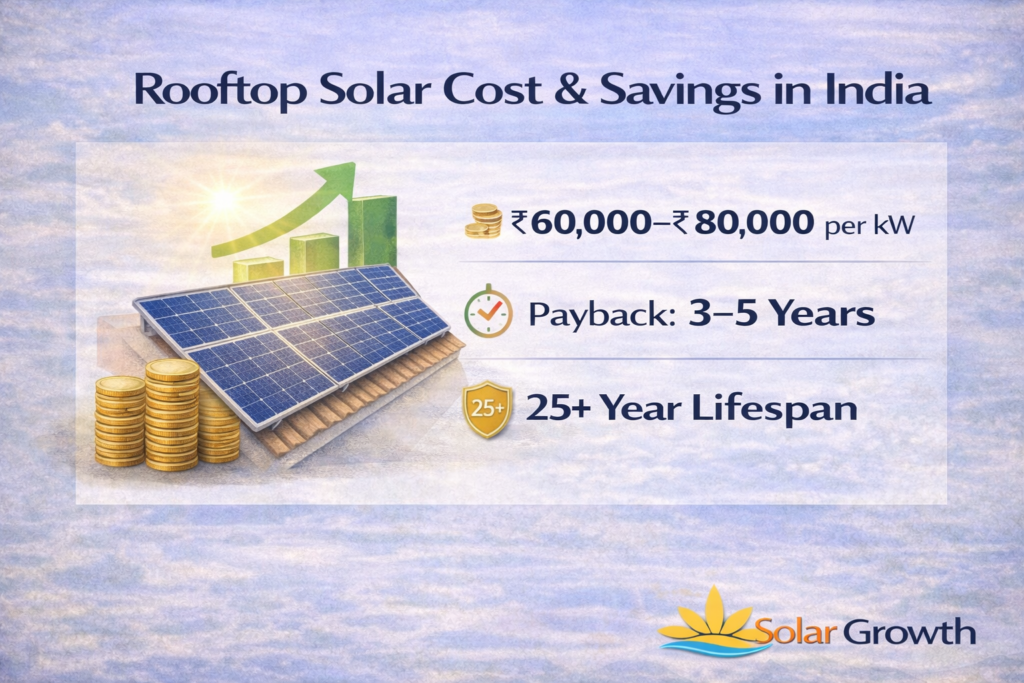
₹60,000 – ₹80,000 per kW
Total System Cost
| System Size | Cost |
| 1 kW | ₹70K – ₹1L |
| 3 kW | ₹1.8L – ₹2.5L |
| 5 kW | ₹3L – ₹4L |
What Affects the Cost of Rooftop Solar in India?
The total cost of a solar system is not fixed and depends on several factors:
- Solar panel quality (mono vs poly)
- Inverter type (string, micro, hybrid)
- Installation complexity
- Roof structure and space
- Location and labour cost
Hidden Costs Most People Ignore
Many homeowners only look at the basic system price and miss additional expenses:
- Structure reinforcement
- Electrical upgrades
- Net metering charges
- Maintenance costs
These can increase your total investment by 5–10% if not planned properly.
Government Subsidy for Rooftop Solar
India offers subsidies for residential solar.
Typical Subsidy
- Up to 40% for small systems
- Reduced for larger systems
Conditions
- Residential use only
- Approved vendors required
- Net metering compliance
To apply properly, refer to How to Apply for Rooftop Solar Subsidy Online India .
ROI and Payback
Example Case:
3 kW system:
- Cost: ₹2L
- Subsidy: ₹40K
- Final cost: ₹1.6L
Savings:
- Monthly savings: ₹2500–₹4000
Payback:
3–5 years
After that:
Almost free electricity for 20+ years
In most Indian cities, solar electricity costs ₹3–₹4 per unit, while grid electricity ranges from ₹6–₹10 per unit this is why solar becomes a strong long-term investment.
Solar Panel Types in India
1. Monocrystalline Panels
- Higher efficiency
- More expensive
2. Polycrystalline Panels
- Lower cost
- Slightly less efficient
Which to Choose?
Monocrystalline for space constraint
Poly for budget
Space Requirement for Rooftop Solar
Approximation:
- 1 kW → 80–100 sq.ft
Example:
| System | Space Needed |
| 1 kW | 100 sq.ft |
| 3 kW | 300 sq.ft |
| 5 kW | 500 sq.ft |
Maintenance of Rooftop Solar Systems
Solar maintenance is simple but critical.
Basic Maintenance Tasks
- Cleaning every 1–3 months
- Checking wiring
- Monitoring performance
Common Issue:
Dust can reduce efficiency by 10–20%.
For full details, see solar panel lifespan and maintenance guide .
Real-Life Example (Home Case Study)
Scenario:
Household in Hyderabad:
- Monthly bill: ₹6000
- Installed 5 kW system
A homeowner in Hyderabad installed a 5 kW system and reduced their electricity bill from ₹6,500 to under ₹1,000 per month.
Results:
- Bill reduced to ₹500–₹1000
- Annual savings: ₹60,000+
- Payback: ~4 years
Advantages of Rooftop Solar
- Lower electricity bills
- Long-term investment
- Low maintenance
- Government incentives
- Clean energy
To understand both sides, see solar energy advantages and disadvantages .
Disadvantages
- High upfront cost
- Weather dependency
- Space limitation
- Poor installation risks
Common Mistakes to Avoid
- Choosing cheapest vendor
- Wrong system size
- Ignoring maintenance
- Not checking subsidy
To avoid errors, read Common Mistakes Businesses Make While Going Solar .
How to Choose the Right Solar EPC
Choosing the right EPC partner is critical.
What to Check:
- Experience
- Projects completed
- Warranty
- After-sales support
Poor EPC = poor performance
Read how to choose the right solar EPC .
Installation Process (Step-by-Step)
- Site survey
- Design
- Approval
- Installation
- Testing
- Commissioning
Factors That Affect Solar Performance
- Location (sunlight hours)
- Panel tilt
- Dust levels
- System quality
Future of Rooftop Solar in India
India is moving toward:
- Higher adoption
- Better storage
- Smart grids
Solar will become mainstream.
Is Rooftop Solar Worth It?
Yes if:
- Proper design
- Quality components
- Right vendor
Otherwise:
Returns will drop
Real ROI Example (How Much You Actually Save)
Let’s take a practical example:
- System size: 3 kW
- Total cost: ₹2,00,000
- Subsidy: ₹40,000
- Final cost: ₹1,60,000
Monthly electricity bill before solar: ₹4,000
After solar: ₹500–₹1,000
Monthly savings: ₹3,000 approx
Real-Life Example: Rooftop Solar in Action
A homeowner in Hyderabad installed a 5 kW rooftop solar system to reduce rising electricity bills.
- Monthly bill before solar: ₹6,000–₹7,000
- System cost: ₹3.5 lakh
- After subsidy: ₹2.8 lakh
After installation:
- Monthly bill reduced to ₹500–₹1,000
- Annual savings: ₹70,000+
- Expected payback: ~4 years
This shows how rooftop solar can become a long-term financial asset when installed correctly.
Payback Calculation:
- Annual savings: ₹36,000
- Payback period: 4–5 years
After that, you generate electricity almost free for the next 20+ years.
Factors That Affect Solar System Performance
Not all solar systems perform the same. Output depends on multiple factors:
| Factor | Impact |
|---|---|
| Location | More sunlight = higher output |
| Panel quality | Higher efficiency panels perform better |
| Installation angle | Incorrect tilt reduces generation |
| Dust and cleaning | Can reduce output by 10–20% |
| System design | Poor design leads to lower savings |
Proper planning and installation play a major role in long-term performance.
What Most Homeowners Get Wrong About Solar
Many people assume solar automatically guarantees savings. But in reality, most problems happen due to:
- Choosing the lowest-cost installer
- Incorrect system sizing
- Ignoring long-term maintenance
Solar works extremely well but only when designed and installed correctly.
Conclusion
Rooftop solar systems in India offer one of the best long-term investments for homeowners. But success depends on planning, execution, and understanding the system completely.
Solar is not just a product, it is a financial and technical decision.
If done correctly, it can deliver consistent savings for decades.
Rooftop Solar vs Grid Electricity Cost Comparison
| Parameter | Solar | Grid Electricity |
|---|---|---|
| Cost per unit | ₹3–₹4 | ₹6–₹10 |
| Price stability | Fixed | Increasing |
| Long-term savings | High | None |
Choosing the right solar system and installer is critical to achieving expected savings and performance.
If your monthly electricity bill is above ₹3,000, installing a rooftop solar system is usually financially beneficial.
Start Your Rooftop Solar Journey Today
Installing a rooftop solar system requires proper planning, system sizing, and expert execution.
Register with us to connect with verified solar providers and get the best solar solution for your home. Free Registration – Solar Growth
You may also find these guides useful:
- Net Metering Explained for Homeowners
- Solar Subsidy Application Guide
- On-Grid vs Off-Grid vs Hybrid Solar
FAQs
1. What is the cost of rooftop solar in India?
₹60,000–₹80,000 per kW depending on system.
2. How long does solar last?
25+ years.
3. Is subsidy available?
Yes, for residential systems.
4. Is solar worth it?
Yes, if properly installed.
Written by Rohith Bingi
Solar Industry Analyst at Solar Growth, covering India’s solar value chain, policy landscape, and business growth trends