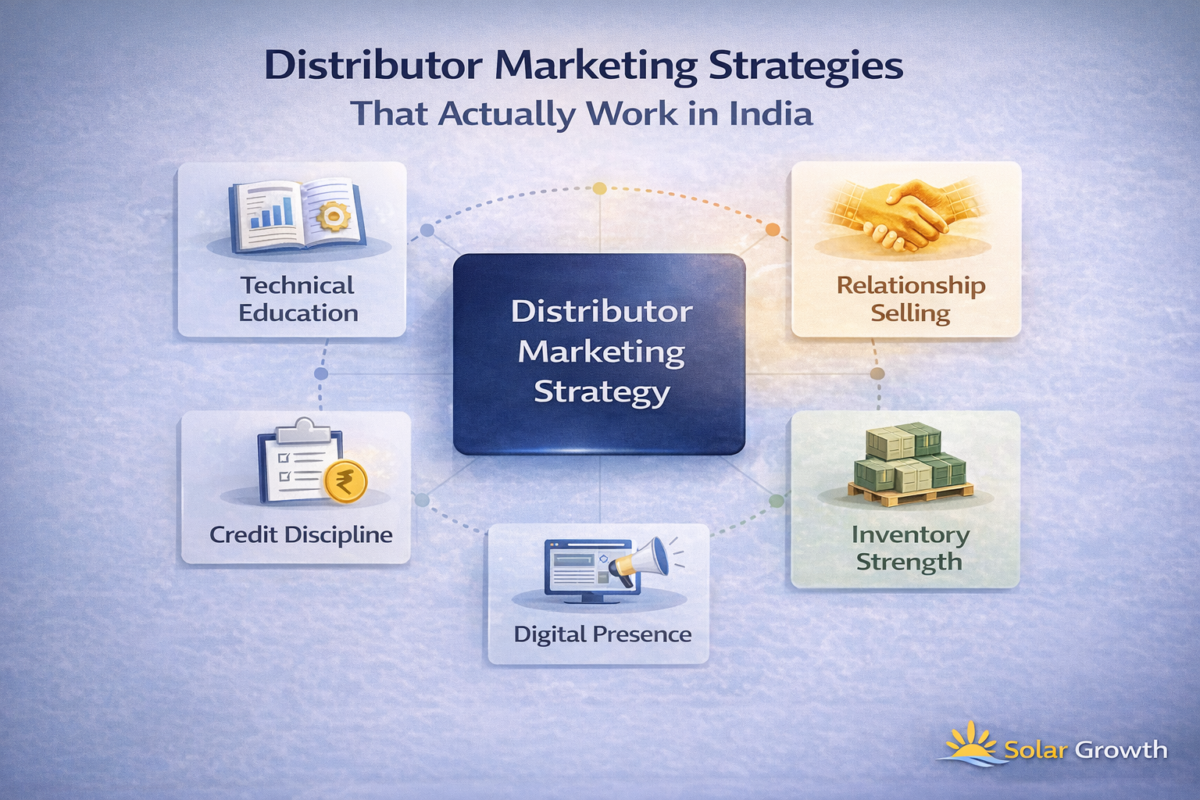
Introduction
Most distributors believe marketing means offering lower prices. That’s a mistake.
In India’s competitive solar and industrial supply market, distributor marketing strategies must go beyond discounting. EPC companies, installers, and dealers choose supply partners based on reliability, responsiveness, and long-term value.
If you want consistent growth as a distributor in India, you need structured marketing systems not random calls or price wars.
This guide explains distributor marketing strategies that actually work, with practical examples from the Indian solar distribution ecosystem.
Why Traditional Distributor Marketing Fails
Many distributors rely on:
- WhatsApp price lists
- Occasional cold calls
- Bulk SMS offers
- Discount-led selling
These methods create transactional customers, not loyal ones.
Real Example
A distributor in Gujarat reduced module pricing repeatedly to gain EPC orders. Revenue increased, but margins collapsed. Within one year, working capital pressure forced scaling down.
Marketing without strategy destroys profitability.
Strategy 1: Define Your Target Segment Clearly
Not all customers are equal.
Segment Your Market
| Segment | Marketing Approach |
| Rooftop EPCs | Fast delivery, moderate credit |
| Utility EPCs | Compliance-heavy documentation |
| Small Installers | Stock availability + training |
| Dealers | Volume discounts |
Trying to market to everyone dilutes impact.
Clarity improves conversion.
Strategy 2: Build Authority Through Technical Education
In B2B distribution marketing strategies, education builds trust.
Practical Methods
- Conduct product training sessions
- Share IEC certification insights
- Explain ALMM updates
- Provide degradation comparison charts
When distributors understand product performance metrics, EPCs treat them as partners not traders.
Strategy 3: Improve Digital Presence (Even for Offline Markets)
Many EPC procurement teams search suppliers online.
Minimum Digital Essentials
- Professional website
- Clear product categories
- Compliance documentation
- Warehouse photos
- Contact details
In India, strong digital credibility increases inbound distributor lead generation.
Strategy 4: Use Relationship-Based Selling
B2B marketing in India remains relationship-driven.
What Works
- Regular office visits
- Industry expo participation
- Technical seminars
- Follow-ups every 30–45 days
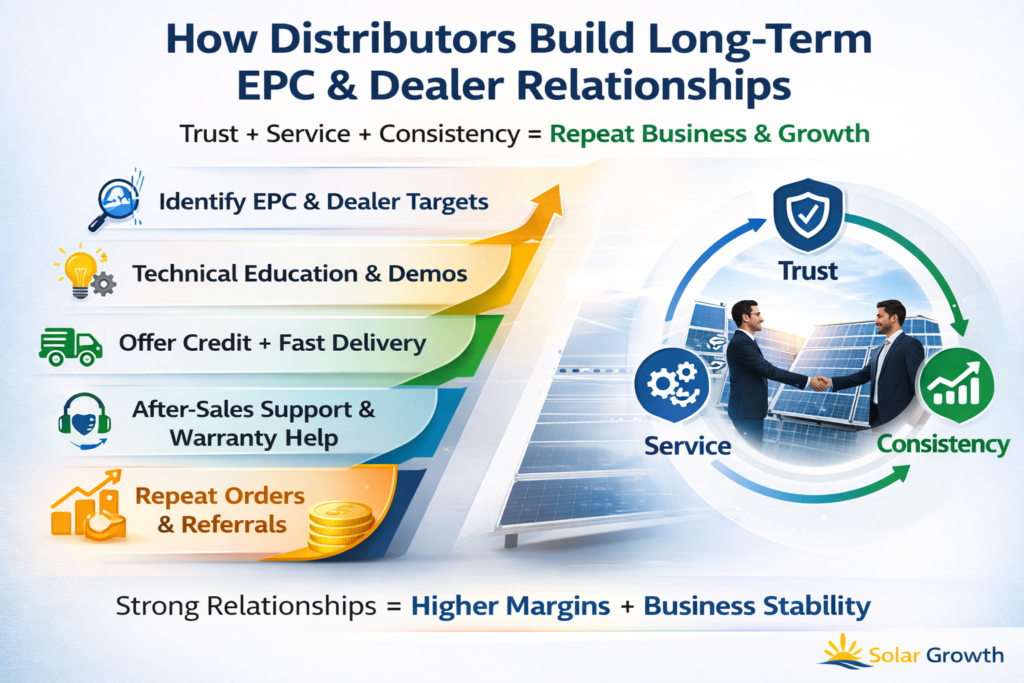
Consistency builds recall.
Strategy 5: Leverage Inventory Strength as a Marketing Asset
If you maintain disciplined inventory management, use it.
For example:
“Ready stock available within 48 hours.”
Fast dispatch reduces EPC project delays.
You can internally link this concept to your guide on Inventory Management Tips for Solar Distributors in India to strengthen authority.
Strategy 6: Offer Structured Credit Policies
Credit can attract EPC customers but only if controlled.
Balanced Credit Table
| Customer Type | Suggested Credit Model |
| Small Installer | 30% advance |
| Mid-size EPC | 20% advance, milestone balance |
| Large Utility EPC | Project-backed credit |
Loose credit is not marketing. It is a risk transfer.
Strategy 7: Focus on After-Sales Support
Many distributors disappear after dispatch.
Top-performing distributors:
- Provide fast replacement support
- Share warranty assistance
- Help with documentation
- Respond within 24 hours
Post-sales reliability creates repeat business.
Strategy 8: Develop Strategic Partnerships
Strong solar distributor marketing in India involves collaboration.
Build Alliances With
- Inverter suppliers
- BOS component vendors
- EPC consultants
- Financing partners
Joint offerings create stronger positioning.
Strategy 9: Track Marketing Performance Metrics
Most distributors do not track ROI.
Metrics to Monitor
- Lead conversion rate
- Repeat order percentage
- Credit recovery cycle
- Gross margin per customer
If repeat orders are below 50%, your marketing lacks retention focus.
Strategy 10: Avoid Common Marketing Mistakes
- Competing only on price
- Ignoring brand positioning
- No customer segmentation
- No follow-up system
- Over-promising delivery
Marketing discipline protects margin.
Case Study: Structured Marketing vs Random Selling
Two distributors in Maharashtra operated in similar regions.
Distributor A:
- Price-led selling
- No digital presence
- High credit exposure
Distributor B:
- Clear rooftop EPC focus
- Technical training sessions
- Moderate credit control
- Consistent follow-ups
After 2 years, Distributor B achieved:
- 65% repeat business
- 20% higher gross margin stability
- Lower bad debt exposure
Marketing is not advertisement. It is positioning.
Compliance as a Marketing Tool
In India’s solar industry, compliance credibility attracts EPCs.
Highlight:
- ALMM compliance
- IEC documentation
- GST transparency
- Insurance-backed supply
EPC procurement teams prefer suppliers who reduce audit risk.
How Distributor Branding Impacts Growth
Branding is not just a logo.
It includes:
- Delivery reliability
- Transparent pricing
- Professional communication
- Consistent service quality
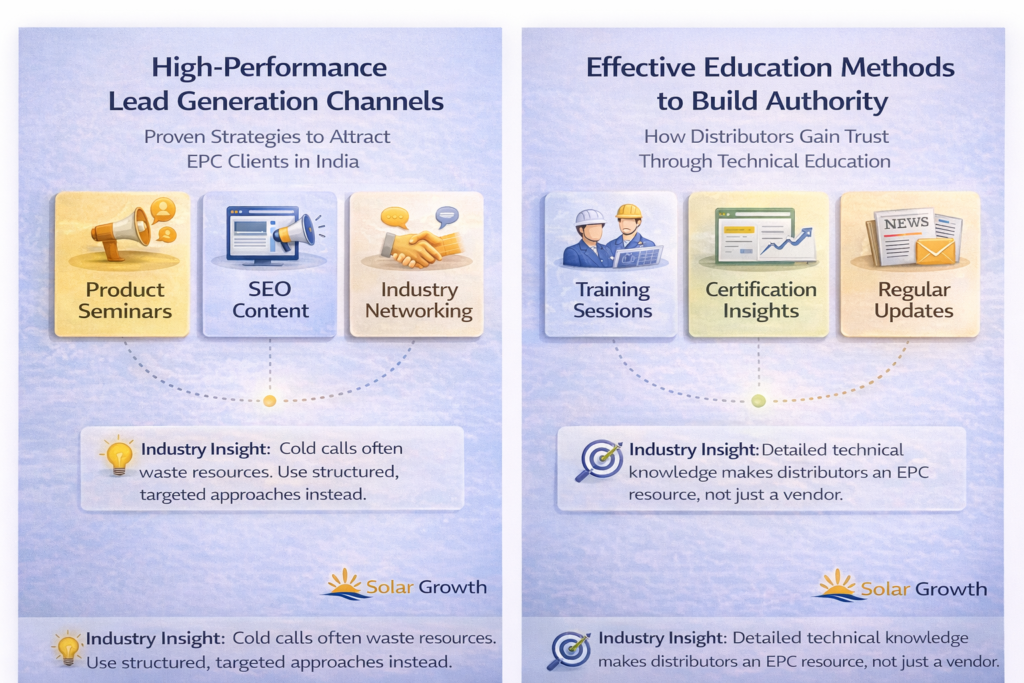
Brand reduces negotiation pressure.
Integration with Business Fundamentals
Marketing works only if backed by:
- Strong inventory control
- Margin discipline
- Reliable logistics
For profitability alignment, read Solar EPC Margins Explained and understand how supply chain decisions impact downstream partners.
Conclusion
Distributor marketing strategies that actually work in India are built on clarity, discipline, and relationship strength.
Price may open doors. Reliability keeps them open.
Distributors who invest in technical knowledge, structured outreach, digital credibility, and disciplined credit management grow sustainably.
Marketing without margin control is noise.
Strategic marketing builds long-term distributor success.
FAQs
1. What is the most effective marketing strategy for distributors in India?
Relationship-driven outreach combined with technical credibility and consistent follow-up delivers strong results.
2. Do distributors need digital marketing?
Yes. A professional website and online visibility improve trust and inbound EPC inquiries.
3. Should distributors compete mainly on price?
No. Competing only on price reduces margins and creates unstable client relationships.
4. How can distributors increase repeat business?
By offering reliable delivery, fast support, transparent communication, and disciplined credit terms.
Written by Rohith Bingi
Solar Industry Analyst at Solar Growth, covering India’s solar value chain, policy landscape, and business growth trends