Introduction
In solar EPC projects, timeline discipline determines profitability. A well-planned project moves smoothly from site survey to commissioning. A poorly planned one faces delays, cost overruns, and penalties.
In India, solar EPC timelines are becoming stricter due to SECI tenders, DISCOM requirements, and private C&I contract conditions. Whether it’s a rooftop project or a utility-scale plant, understanding the complete Solar EPC project timeline is essential for execution teams, founders, and bid managers.
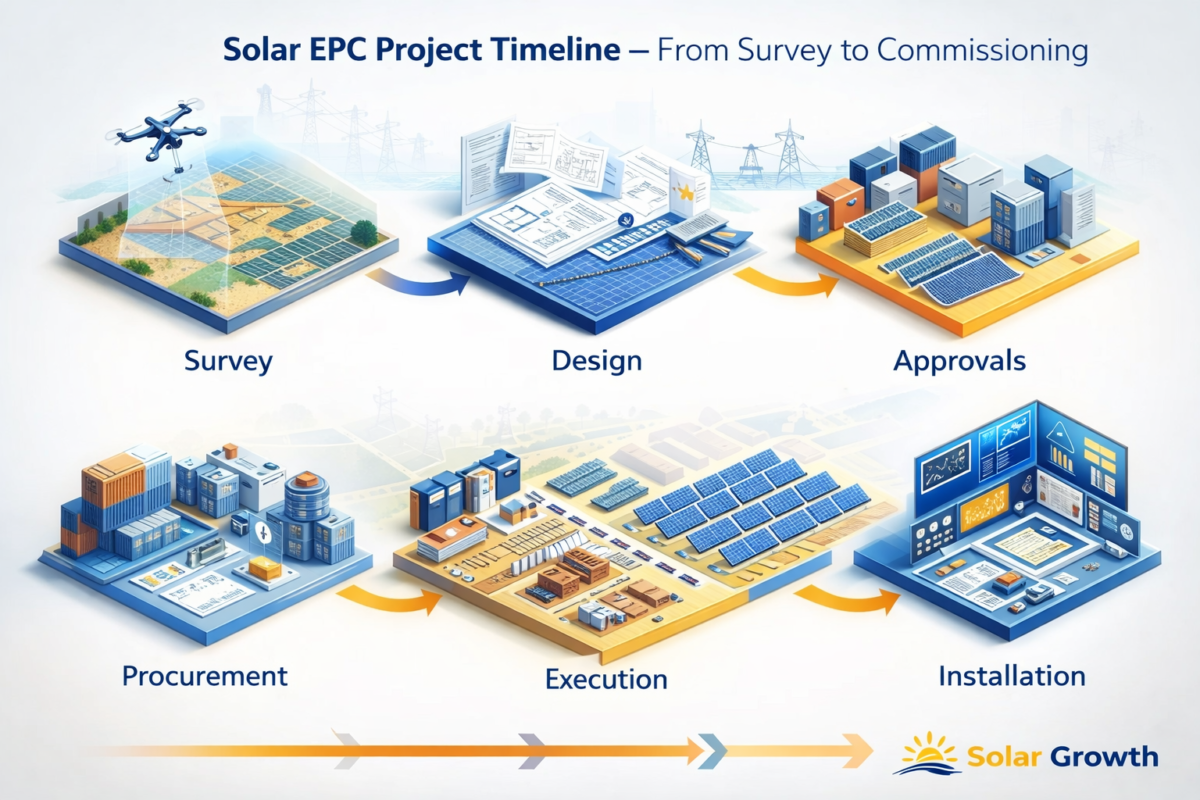
This guide explains each stage of the Solar EPC lifecycle in India with realistic timelines, risks, and best practices.
Phase 1: Site Survey and Feasibility Assessment
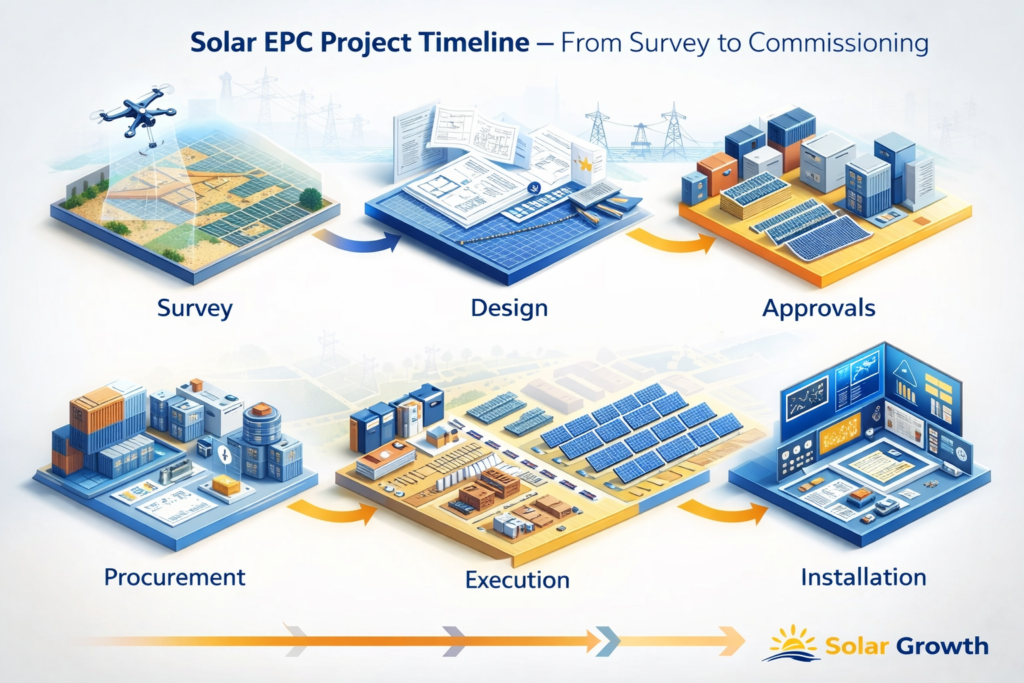
Typical Timeline: 3–14 days (Rooftop) | 2–6 weeks (Utility-scale)
This is where strong projects begin.
What Happens in This Stage?
- Site inspection
- Shadow analysis
- Soil testing (for ground-mounted)
- Roof structural assessment (for rooftop)
- Grid connection feasibility
- Preliminary energy generation estimates
Industry Best Practice
In India, failing to conduct proper soil testing is one of the biggest causes of civil rework in utility-scale projects.
Example:
A 20 MW project in Rajasthan faced foundation redesign due to underestimated soil bearing capacity. The result? A 6-week delay and increased civil cost.
Common Mistakes
- Relying only on Google Maps imagery
- Skipping detailed roof load testing
- Not verifying nearby substation capacity
A strong survey reduces future delays by up to 20–30%.
Phase 2: Detailed Engineering & Design
Typical Timeline: 2–6 weeks
Once feasibility is confirmed, engineering begins.
Deliverables Include:
- Detailed SLD (Single Line Diagram)
- Module layout design
- Cable routing plan
- Structural drawings
- Inverter sizing
- Protection and earthing plan
Standards to Follow
- IEC 61215 / IEC 61730 (Module standards)
- IEC 62446 (Commissioning documentation)
- CEA grid connectivity regulations (India)
Best Practice
Freeze design before procurement.
Late design changes are a major reason for EPC project timeline extensions.
Phase 3: Approvals & Documentation
Typical Timeline: 2–8 weeks (depends on project type)
This stage runs parallel to engineering.
Approvals May Include:
- DISCOM approval
- Net metering approval (rooftop)
- CEIG approval
- Environmental clearance (utility-scale)
- PPA signing
- Grid connectivity approval
Risk Area
Utility-scale projects in India often face grid evacuation delays. EPC teams must coordinate early with transmission authorities.
Pro Tip:
Track approvals as separate milestones, not side activities.
Phase 4: Procurement & Supply Chain
Typical Timeline: 4–12 weeks
Procurement must align with project scheduling.
Major Components:
| Component | Risk Level | Lead Time |
| Solar Modules | Medium | 4–8 weeks |
| Inverters | High | 6–10 weeks |
| Transformers | Very High | 8–14 weeks |
| Mounting Structures | Medium | 3–6 weeks |
Best Practices
- Use MNRE ALMM-listed modules
- Maintain approved vendor lists
- Lock delivery dates contractually
- Track weekly procurement status
Real Example
Many EPC delays during 2022–23 in India occurred due to inverter shipment backlogs.
Procurement delays often affect commissioning more than execution.
Phase 5: Civil & Structural Work
Typical Timeline: 3–8 weeks
This stage depends heavily on soil and weather conditions.
Activities:
- Land leveling
- Foundation work
- Structure erection
- Cable trenching
Delay Risk Factors
- Monsoon season
- Rock excavation
- Labour availability
Best Practice
Always add contingency buffer during monsoon planning in India.
Skipping weather planning is a predictable mistake.
Phase 6: Electrical Installation
Typical Timeline: 2–6 weeks
Includes:
- Module mounting
- DC cabling
- Inverter installation
- LT & HT cabling
- SCADA installation
Quality Control Matters
Improper DC termination causes rework during commissioning.
EPC companies that conduct internal QA checks reduce commissioning failures significantly.
Phase 7: Testing & Commissioning
Typical Timeline: 1–3 weeks
This is the most sensitive stage.
Commissioning Checklist:
- Insulation resistance testing
- String testing
- Inverter testing
- Protection relay testing
- Synchronization with grid
- Performance test
Documentation Required:
- As-built drawings
- Test certificates
- CEIG clearance
- Grid synchronization certificate
Penalty Risk
Most solar EPC penalties are linked to missed commissioning deadlines.
Understanding contractual COD (Commercial Operation Date) is critical.
Complete Solar EPC Project Timeline Summary
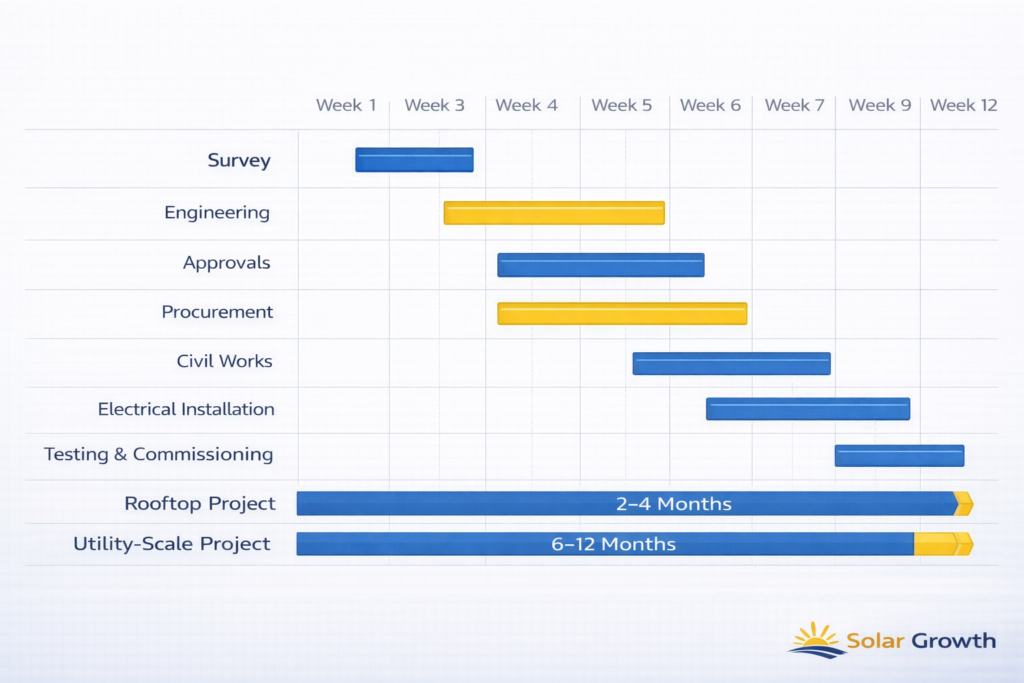
| Stage | Rooftop Project | Utility-Scale Project |
| Survey | 1–2 weeks | 2–6 weeks |
| Design | 2–4 weeks | 4–6 weeks |
| Approvals | 2–4 weeks | 4–8 weeks |
| Procurement | 4–8 weeks | 6–12 weeks |
| Execution | 4–6 weeks | 8–16 weeks |
| Commissioning | 1–2 weeks | 2–3 weeks |
Total Timeline:
- Rooftop EPC: 2–4 months
- Utility-scale EPC: 6–12 months
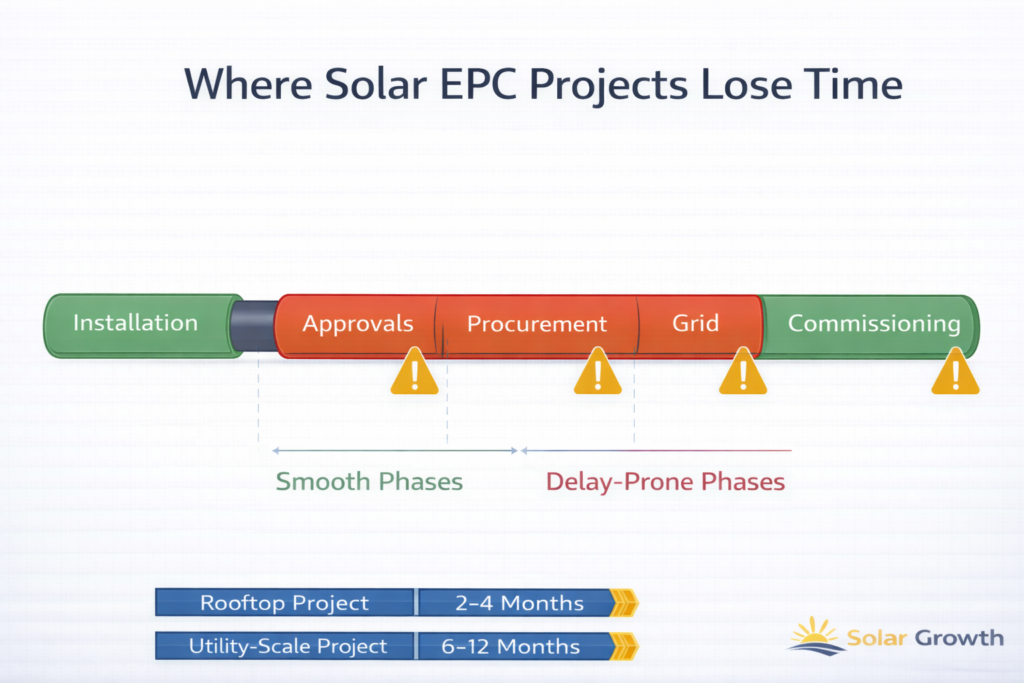
Where Solar EPC Projects Lose Time
- Delayed procurement decisions
- Poor coordination with utilities
- Unrealistic scheduling in bids
- Late material delivery
- Weak site supervision
Project timeline control is not about speed, it’s about coordination.
Best Practices to Maintain Timeline Discipline
- Freeze design early
- Create milestone-based execution tracking
- Conduct weekly review meetings
- Align procurement with execution schedule
- Maintain real-time progress reporting
- Keep documentation ready during execution
Strong project management reduces penalties and protects margins.
Conclusion
A successful Solar EPC project timeline depends on planning accuracy, procurement discipline, engineering clarity, and execution control.
In India’s competitive solar market, timeline management directly impacts profitability. EPC companies that treat scheduling as a strategic function not just an operational task consistently outperform competitors.
From survey to commissioning, every phase must be structured, monitored, and aligned with contractual commitments.
Written by Rohith
Solar Industry Analyst at Solar Growth, covering India’s solar value chain, policy landscape, and business growth trends