Introduction
India’s solar market is expanding rapidly due to rooftop adoption, C&I demand, and government policy support. But while installers and EPC companies get attention, solar panel distributors quietly control the supply chain.
If you want to become a solar panel distributor in India, you need more than a warehouse and a GST number. This is a working capital–heavy, margin-sensitive, relationship-driven business.
This guide explains how to start a solar panel distribution business in India, including investment requirements, margins, supplier selection, risks, and practical strategies.
Understanding the Solar Distribution Business Model
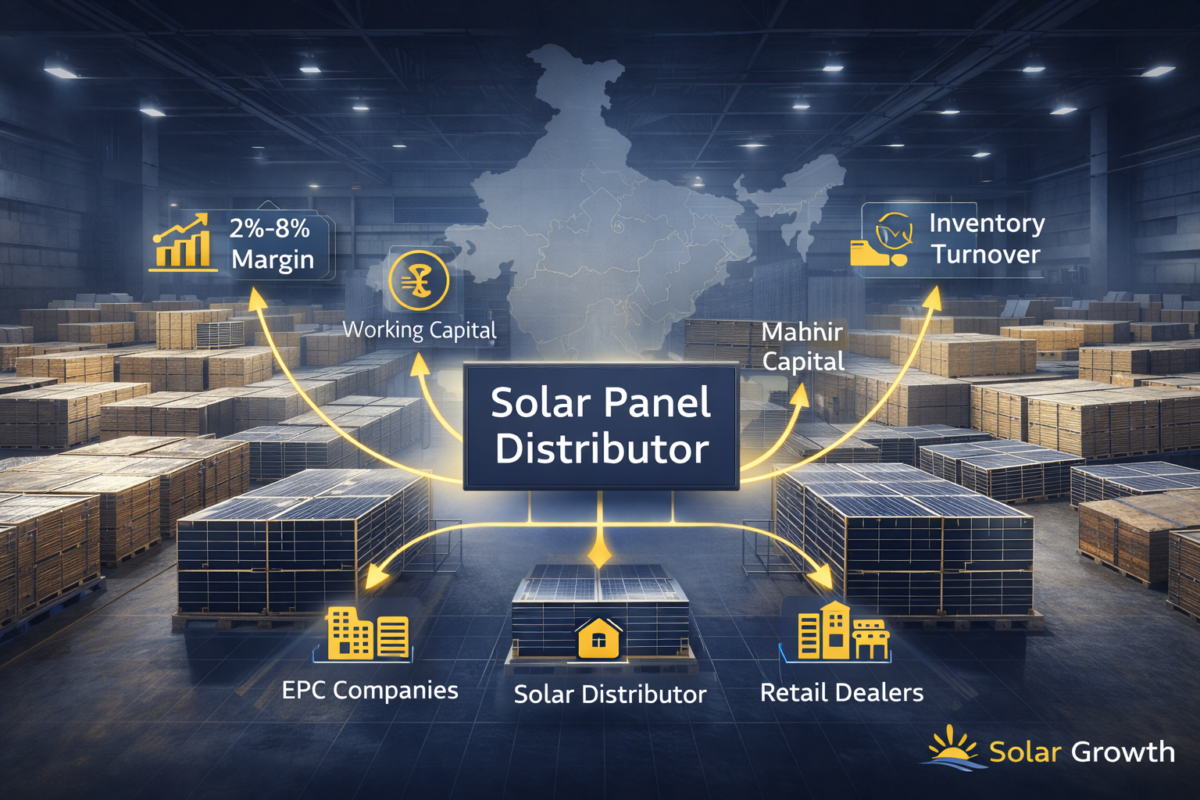
A solar panel distributor acts as an intermediary between:
- Solar module manufacturers
- EPC companies
- Installers
- Retail dealers
Revenue comes from margin spread between manufacturer price and dealer price.
Typical Margin Range in India
| Level | Margin Range |
| National Distributor | 2%–5% |
| Regional Distributor | 4%–8% |
| Sub-Dealer | 3%–6% |
Margins are thin. Volume and credit control determine profitability.
Step 1: Study Your Regional Market
Before applying for any solar panel dealership in India, evaluate:
- Rooftop demand in your state
- Presence of EPC companies
- Net metering activity
- Local competition
- Average monthly module movement
Example
In states like Gujarat and Maharashtra, C&I rooftop demand supports higher distributor turnover. In smaller markets, working capital may sit idle for months.
Practical insight: Choose your geography carefully. Distribution is local-volume driven.
Step 2: Choose the Right Manufacturer
Not all module brands offer distributorships easily.
What Manufacturers Look For
- Working capital strength
- Existing dealer network
- Warehouse infrastructure
- Creditworthiness
- Past electrical or industrial distribution experience
Types of Module Suppliers in India
- Tier-1 Indian manufacturers (ALMM listed)
- Imported module brands
- Domestic mid-tier brands
Always verify:
- MNRE ALMM compliance
- IEC certifications (IEC 61215, IEC 61730)
- Warranty backing structure
Choosing the wrong supplier can kill your solar wholesale business in India.
Step 3: Investment & Working Capital Planning
Be realistic. This is not a small capital business.
Typical Investment Breakdown
| Expense Head | Estimated Requirement |
| Initial stock purchase | ₹50 lakh – ₹2 crore |
| Warehouse setup | ₹5–15 lakh |
| Logistics arrangement | ₹3–10 lakh |
| Staff & operations | ₹3–8 lakh/month |
| Credit buffer | 30–60 days stock value |
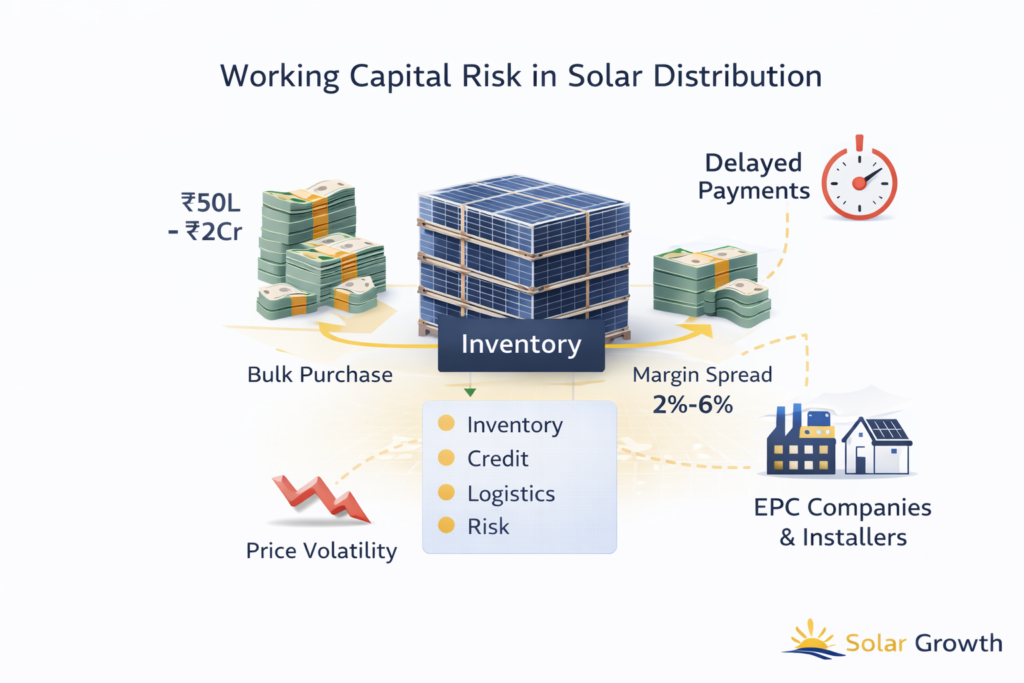
Most manufacturers require minimum stock commitments.
Reality check: Your biggest risk is blocked capital, not competition.
Step 4: Legal & Compliance Setup
To operate as a solar panel distributor in India, you need:
- GST registration
- Trade license
- Warehouse lease agreement
- MSME registration (optional but helpful)
- Proper invoicing and E-way bill compliance
For government-linked supply, vendors may require:
- ISO certification
- Udyam registration
- Bank solvency proof
Compliance delays often cause distributor rejection.
Step 5: Warehouse & Logistics Planning
Solar modules are fragile.
Warehouse requirements:
- Covered storage
- Moisture control
- Stacking discipline
- Damage insurance
Logistics strategy:
- Tie up with reliable transporters
- Monitor loading/unloading handling
- Inspect consignments immediately
A single damaged container can wipe out a month’s margin.
Step 6: Build a Dealer & Installer Network
This is where real business happens.
Target Customers
- Rooftop EPC companies
- Local installers
- Electrical contractors
- Solar retailers
How to Build Network
- Visit industrial clusters
- Partner with inverter distributors
- Attend renewable expos
- Offer credit only to verified clients
Distribution is relationship-driven.
Step 7: Credit Control – Your Survival Factor
Most solar distribution failures happen due to bad credit management.
Common issues:
- 60–90 day payment delays
- Installers defaulting after project delays
- Payment blocked in government-linked projects
Best Practices
- Credit insurance where possible
- Stage-based supply
- Background verification of clients
- Limit credit exposure per customer
An 8% gross margin disappears quickly with delayed payments.
Profitability: How Solar Distributors Actually Make Money
Many assume distribution is easy margin.
It’s not.
Profit Drivers
- Bulk buying discounts
- Early payment incentives from manufacturers
- Volume turnover
- Efficient logistics
- Low credit default rate
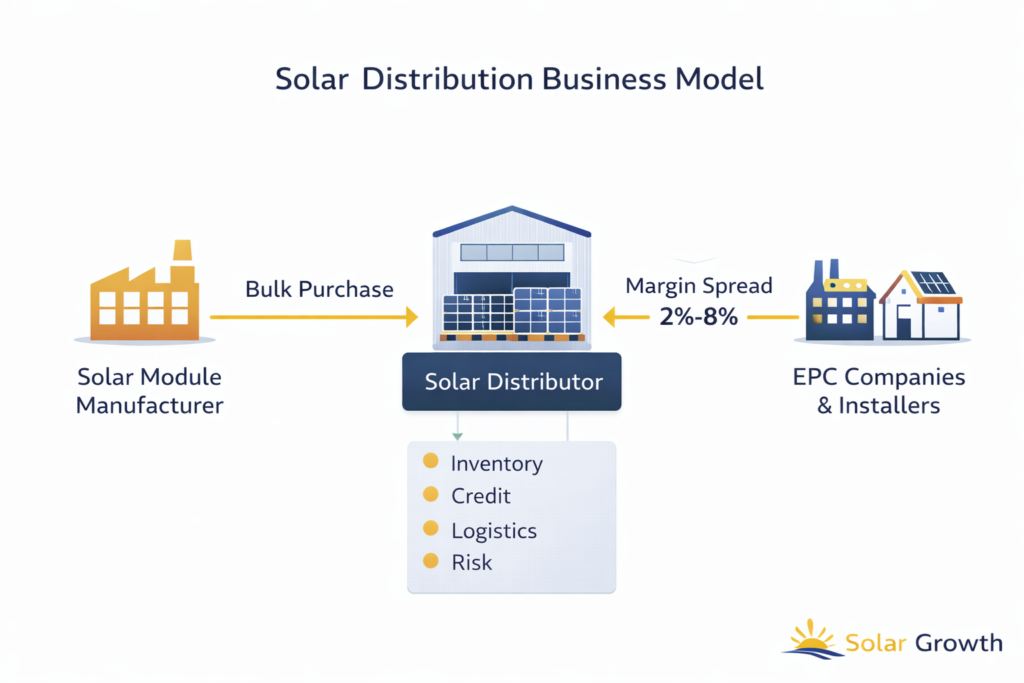
Hidden Margin Killers
- Damaged stock
- Price drops after bulk purchase
- Warranty disputes
- GST errors
Common Mistakes New Distributors Make
- Over-stocking during price peaks
- Extending credit aggressively
- Choosing unknown brands
- Ignoring ALMM updates
- Underestimating transport damage risk
Distribution rewards discipline, not aggression.
Risk Factors in Indian Solar Distribution
- Module price volatility
- Policy changes
- Import duty revisions
- ALMM updates
- Currency fluctuations
In 2022–23, many distributors suffered inventory losses due to sudden price corrections.
Scaling Strategy: From Regional to State-Level Distributor
Once stable, scaling requires:
- Expanding warehouse network
- Hiring regional sales managers
- Multi-brand portfolio
- Strong ERP system
Distribution scale is operational, not marketing-driven.
Is Solar Distribution Still Profitable in India?
Yes but selectively.
It works best if:
- You have strong working capital
- You control credit exposure
- You build installer loyalty
- You manage inventory turnover tightly
Distribution is a finance-driven business more than a technical one.
Conclusion
Becoming a solar panel distributor in India requires financial strength, operational discipline, and strategic supplier selection. Margins are thin, competition is high, and working capital risk is real.
However, with structured planning, controlled credit exposure, and strong regional networks, solar distribution remains a viable and scalable business opportunity in India’s growing renewable sector.
FAQs
1. How much investment is required to become a solar panel distributor in India?
Typically ₹50 lakh to ₹2 crore depending on brand, region, and stock commitment.
2. What is the margin for solar panel distributors?
Margins range from 2%–8% depending on distribution level and volume.
3. Is ALMM compliance mandatory?
Yes, for the government and many EPC-linked projects in India.
4. Is solar distribution profitable in 2026?
Yes, if working capital and credit risks are managed carefully.
Written by Rohith Bingi
Solar Industry Analyst at Solar Growth, covering India’s solar value chain, policy landscape, and business growth trends