Introduction
Solar power adoption in India has grown rapidly in the past decade. Businesses across manufacturing, IT, logistics, and commercial real estate are increasingly shifting to renewable energy to reduce electricity costs and meet sustainability goals.
However, installing a solar power plant requires significant capital investment. Many companies prefer a solution that allows them to access solar energy without paying upfront installation costs.
This is where a Solar Power Purchase Agreement (PPA) becomes important.
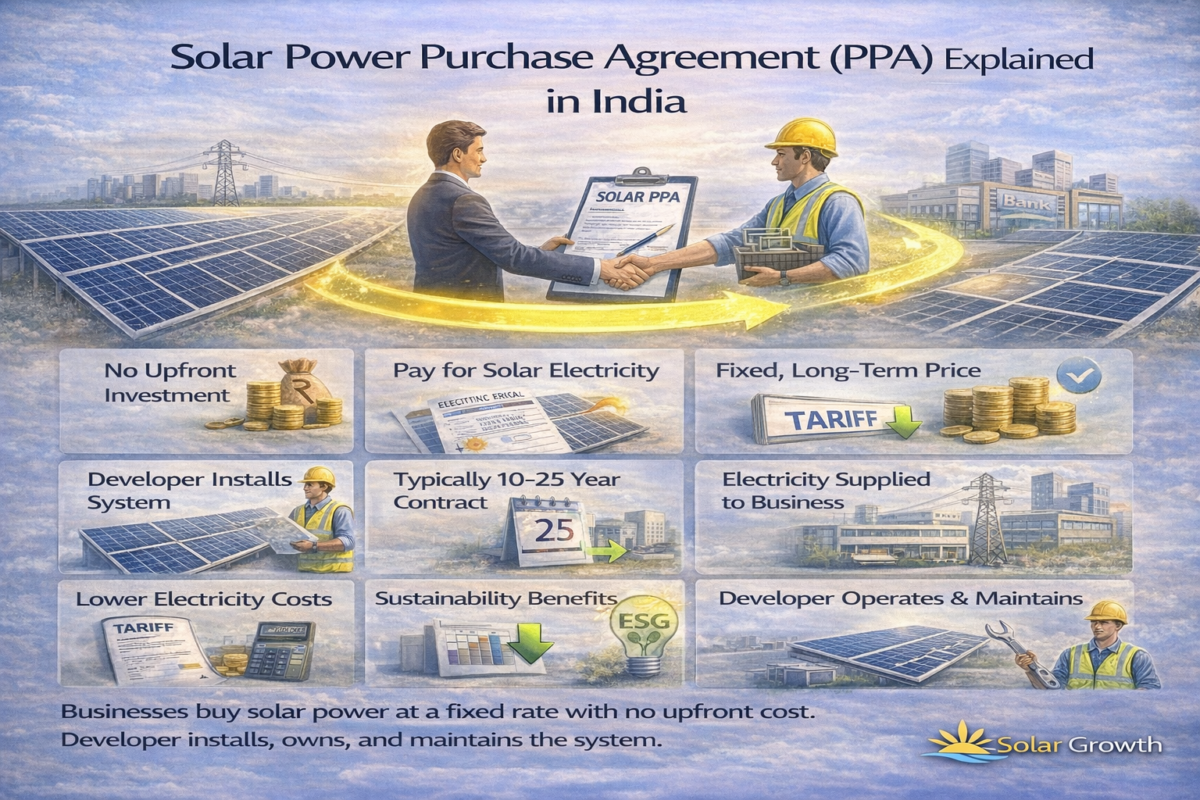
A solar PPA allows businesses to purchase electricity generated from a solar power system at a fixed price for a long-term contract period. The solar developer installs, owns, and operates the solar plant, while the business simply buys the electricity it produces.
This guide explains how solar PPAs work in India, including contract structures, pricing models, benefits, risks, and key considerations for businesses evaluating renewable energy procurement.
What Is a Solar Power Purchase Agreement (PPA)?
A Solar Power Purchase Agreement (PPA) is a long-term contract between a solar power developer and a consumer.
Under this agreement:
- The developer installs and owns the solar system.
- The consumer agrees to buy electricity generated by the system.
- The electricity is purchased at a predetermined tariff for a fixed contract duration.
Typical PPA contracts last between 10 and 25 years.
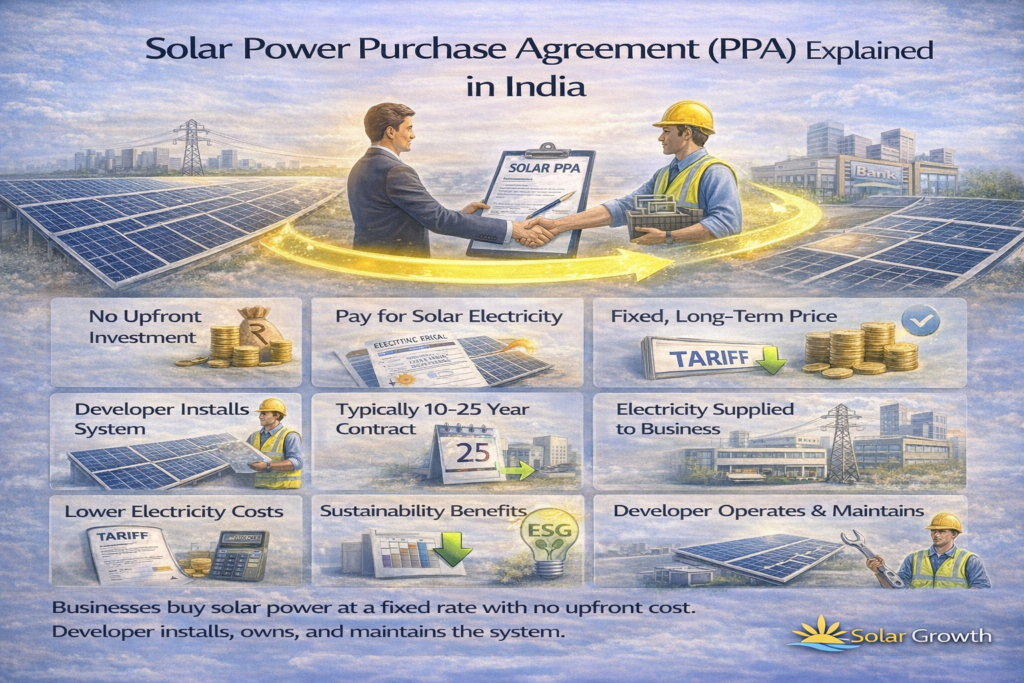
Solar PPAs are widely used by businesses that want to reduce electricity costs without making large capital investments.
How Solar PPAs Work in India
The solar PPA model involves several key participants.
Key Stakeholders
- Solar developer or EPC company
- Business or industrial consumer
- Electricity distribution company (DISCOM)
- Regulatory authorities
- Financing institutions
Basic Process
- A solar developer evaluates the business’s electricity consumption.
- A solar power plant is designed to meet part of the demand.
- The developer installs and owns the system.
- The business signs a long-term PPA to purchase electricity.
- Electricity generated by the system is supplied to the facility.
The consumer pays for electricity generated rather than the equipment itself.
Types of Solar PPA Models in India
Solar PPAs can be structured in different ways depending on project location and ownership.
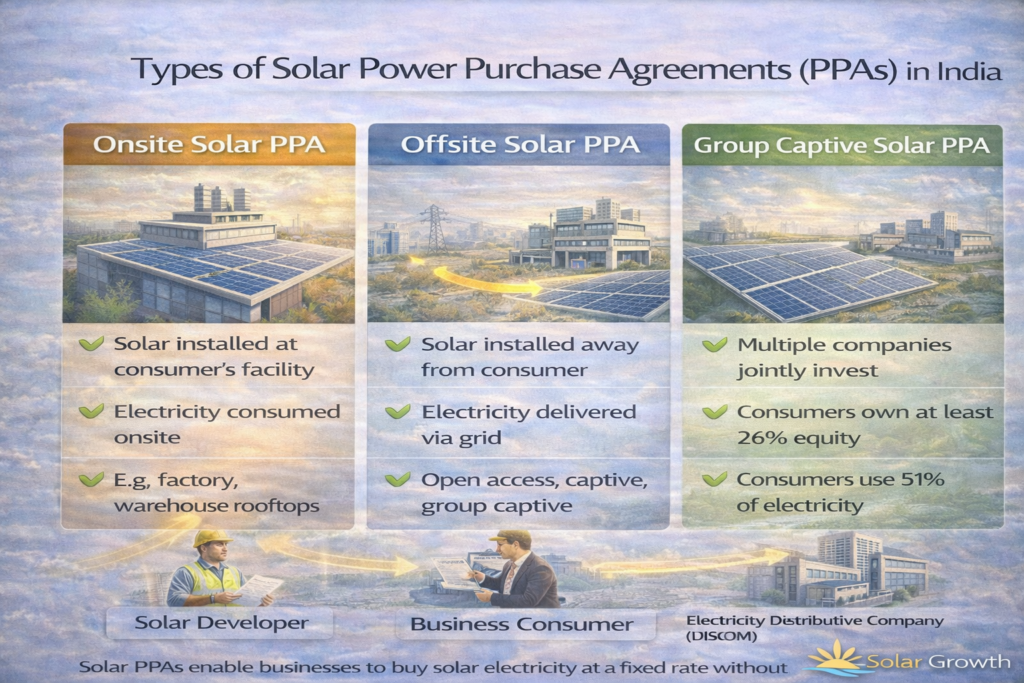
1. Onsite Solar PPA
In this model, solar panels are installed directly on the consumer’s premises.
Examples include:
- Factory rooftops
- Warehouse rooftops
- Commercial buildings
The electricity generated is consumed immediately within the facility.
Advantages include reduced transmission losses and faster implementation.
2. Offsite Solar PPA
In offsite PPAs, the solar power plant is located away from the consumer’s premises.
Electricity is delivered through the grid using:
- Open access
- Captive or group captive structures
This model allows businesses without rooftop space to access solar energy.
3. Group Captive PPA
Under group captive models:
- Multiple companies jointly invest in a solar plant.
- Each company consumes a portion of electricity produced.
To qualify under Indian regulations:
- Consumers must collectively hold at least 26% equity.
- Consumers must consume at least 51% of the electricity generated.
This model often provides lower electricity tariffs due to regulatory exemptions.
Solar PPA Pricing Structure
Solar PPA tariffs are typically fixed or partially escalated over time.
Typical PPA Pricing Models
| Pricing Model | Description |
| Fixed tariff | Electricity price remains constant throughout contract |
| Escalation tariff | Tariff increases annually by a fixed percentage |
| Hybrid pricing | Combination of fixed and escalation pricing |
In India, solar PPA tariffs often range between ₹3 and ₹6 per unit, depending on project size and location.
This is usually lower than commercial grid electricity tariffs.
Example: Solar PPA Savings for Businesses
Consider a manufacturing facility consuming 2 million units of electricity per year.
Grid electricity tariff:
₹9 per unit
Annual Electricity Cost
₹1.8 crore
Now assume the business signs a solar PPA at ₹4.5 per unit.
New Electricity Cost
₹90 lakh per year
Annual Savings
₹90 lakh
Over a 20-year contract period, potential savings can exceed ₹15 crore, depending on tariff escalation.
Advantages of Solar PPAs
Solar PPAs offer several benefits for businesses.
1. No Upfront Capital Investment
The solar developer funds the project.
Businesses avoid high installation costs.
2. Lower Electricity Costs
Solar tariffs are often significantly lower than grid tariffs.
3. Predictable Energy Pricing
Long-term contracts provide price stability.
4. Sustainability and ESG Benefits
Businesses reduce carbon emissions and improve sustainability reporting.
5. Minimal Operational Responsibility
Developers handle installation, maintenance, and monitoring.
Risks and Considerations in Solar PPAs
While PPAs offer advantages, businesses should evaluate potential risks.
Long-Term Contract Commitment
Most PPAs last between 15 and 25 years.
Early termination may involve penalties.
Regulatory Policy Changes
Energy policies and open access charges may change over time.
Developer Reliability
Project success depends heavily on the solar developer’s expertise.
Energy Consumption Variability
Changes in energy demand may affect financial savings.
Key Terms in Solar PPA Contracts
Understanding PPA contract terms is essential.
Contract Duration
Typically 15–25 years.
Tariff Structure
Defines electricity pricing and escalation terms.
Minimum Energy Offtake
Defines minimum electricity consumption requirements.
Performance Guarantees
Ensures the system produces a minimum amount of energy.
Termination Clauses
Defines penalties or conditions for contract termination.
Common Mistakes Businesses Make
Many companies evaluating solar PPAs overlook important details.
Common mistakes include:
- Signing agreements without legal review
- Ignoring escalation clauses
- Overestimating energy savings
- Choosing inexperienced developers
A careful financial and legal review is critical.
Best Practices Before Signing a Solar PPA
Businesses should take several steps before entering a PPA agreement.
Conduct an Energy Audit
Understand current electricity consumption patterns.
Evaluate Multiple Developers
Compare pricing, project experience, and financial strength.
Review Contract Terms Carefully
Seek legal and financial advice before signing.
Analyze Long-Term Savings
Consider tariff escalation and policy changes.
Industry Trends in Corporate Solar PPAs
Corporate renewable energy procurement is growing globally and in India.
Large companies increasingly use solar PPAs to:
- Achieve renewable energy targets
- Stabilize energy costs
- Meet sustainability commitments
Technology companies, manufacturing firms, and logistics operators are among the largest adopters.
Conclusion
Solar Power Purchase Agreements have become one of the most effective ways for businesses in India to adopt renewable energy without large upfront investments.
By allowing companies to purchase solar electricity at predictable long-term prices, PPAs provide both financial savings and sustainability benefits.
However, successful implementation requires careful evaluation of contract terms, developer credibility, and regulatory policies.
For many organizations, solar PPAs represent a practical and financially attractive path toward cleaner energy and lower electricity costs.
FAQs
1. What is a solar power purchase agreement?
A solar PPA is a long-term contract where a business purchases electricity generated by a solar system owned and operated by a developer.
2. How long do solar PPA contracts last?
Most solar PPA agreements last between 10 and 25 years.
3. Are solar PPAs cheaper than grid electricity?
Yes. Solar PPA tariffs are often lower than commercial electricity tariffs, resulting in significant cost savings.
4. Can small businesses use solar PPAs?
Solar PPAs are most common for medium and large power consumers, but smaller businesses can also participate depending on project size and policy conditions.
Written by Rohith Bingi
Solar Industry Analyst at Solar Growth, covering India’s solar value chain, policy landscape, and business growth trends