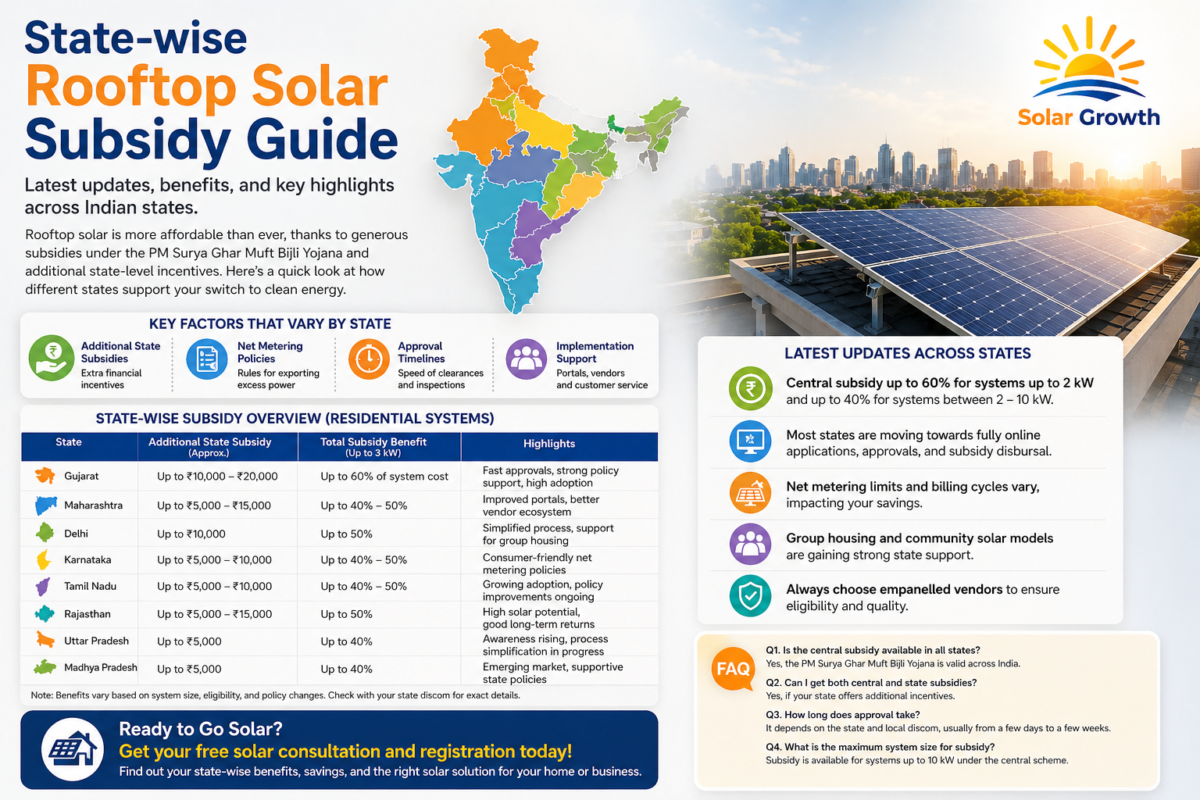
India’s rooftop solar push is gaining real momentum, and much of that progress is now being driven at the state level. While the Ministry of New and Renewable Energy sets the national framework, individual states are shaping how subsidies, approvals, and net metering actually work on the ground. For homeowners and small businesses, understanding these state wise differences can make a significant impact on total savings and project timelines.
At the national level, the PM Surya Ghar Muft Bijli Yojana remains the backbone of rooftop solar adoption. It offers central financial assistance for residential systems, especially up to 3 kW and 10 kW categories. However, what many people miss is that several states offer additional incentives on top of this, effectively reducing the upfront cost even further.
In states like Gujarat, rooftop solar adoption has been particularly strong. The state government has consistently supported residential solar through additional subsidies and streamlined processes. Consumers here often benefit from faster approvals and proactive distribution companies, making installation smoother compared to many other regions. Gujarat’s model is frequently seen as a benchmark for high adoption rates.
Maharashtra, on the other hand, offers solid infrastructure but has historically faced challenges with approval timelines. That said, recent improvements in online portals and vendor empanelment are helping reduce delays. Subsidy benefits remain aligned with central schemes, and net metering policies continue to support residential users effectively.
Delhi has taken a slightly different approach by focusing on ease of access and awareness. Along with central subsidies, the city has promoted group housing solar adoption and simplified application processes. Residents in apartments and societies are increasingly able to participate through shared rooftop systems, which is a growing trend in urban areas.
In southern states like Karnataka and Tamil Nadu, solar adoption is steadily rising. Karnataka benefits from relatively consumer friendly net metering policies, making it attractive for both homes and small businesses. Tamil Nadu has also improved its policy structure, although implementation speed can vary depending on the local distribution company.
Rajasthan stands out due to its natural solar potential. The state government has been supportive of rooftop installations, particularly in residential and agricultural segments. Subsidies combined with high solar generation levels make systems financially rewarding over the long term.
Uttar Pradesh and Madhya Pradesh are emerging markets in the rooftop solar space. While awareness is still growing, policy support has improved significantly. Subsidies under central schemes are available, and state authorities are working on simplifying procedures to encourage more households to adopt solar.
One important policy layer across all states is net metering. While the core concept remains the same, allowing consumers to export excess electricity and receive bill credits, the exact rules can differ. Some states cap system sizes, while others adjust billing cycles or compensation rates. It is essential to understand these local regulations before installation, as they directly affect your return on investment.
Another key aspect is vendor selection. Most subsidy linked installations require choosing from government empanelled vendors. This ensures quality and compliance but can also influence pricing and timelines. States are now improving vendor ecosystems to balance affordability with service quality.
Recent updates across multiple states also highlight a push toward digital processes. From application to inspection and subsidy disbursal, everything is gradually moving online. This reduces paperwork, improves transparency, and speeds up project completion. For consumers, this means fewer follow ups and a more predictable installation journey.
Overall, the direction is clear. While the central government provides the foundation, states are becoming the real drivers of rooftop solar adoption. The difference in subsidies may not always be huge, but variations in execution, approvals, and net metering policies can significantly influence your experience and savings.
If you are planning to install rooftop solar, understanding your state specific benefits is essential. The right combination of central subsidy, state support, and efficient installation can dramatically reduce your costs and increase long term returns. You can take the first step by exploring the free registration to get a customized estimate based on your location and energy needs.
FAQs
1. Do all states offer additional solar subsidies
Not all states provide extra subsidies beyond the central scheme, but many offer indirect benefits like faster approvals or better net metering policies.
2. Is the subsidy amount the same across India
The central subsidy is uniform, but total benefits can vary depending on state level incentives and policies.
3. What is the role of state governments in rooftop solar
States handle implementation, approvals, net metering rules, and local distribution company coordination.
4. Can I install solar without state approval
No, approvals from the local electricity distribution company are required for grid connected systems.
5. Which state is best for rooftop solar in India
Gujarat is often considered a leader due to strong policy support and high adoption, but many other states are catching up quickly.
6. How do I know which subsidy I am eligible for
Eligibility depends on your system size, location, and whether you meet the criteria under central and state schemes.