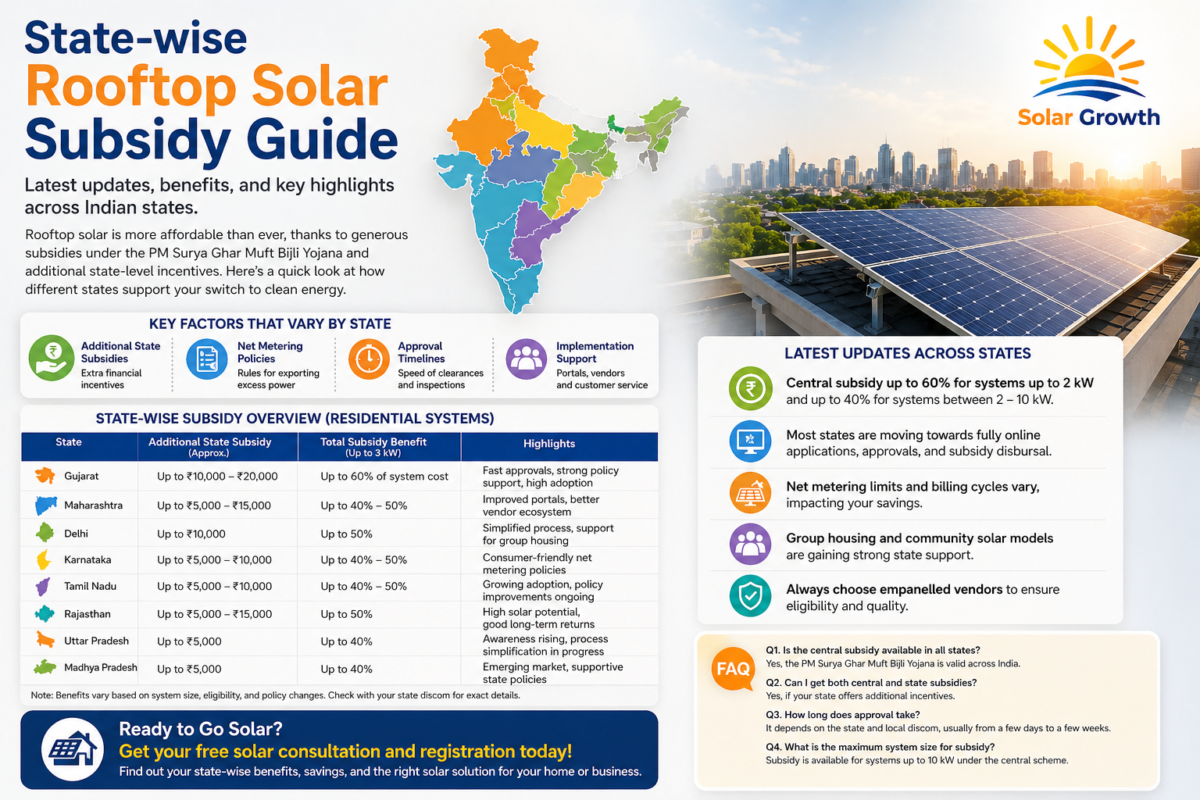
India’s rooftop solar market is expanding rapidly, and much of this growth is being shaped by state level policies and incentives. While the central government provides the foundation through national subsidy schemes, individual states play a major role in determining how smoothly rooftop solar systems are approved, installed, and connected to the grid. For homeowners and businesses, understanding these state wise differences has become increasingly important.
The biggest driver of residential solar adoption remains the PM Surya Ghar Muft Bijli Yojana introduced by the Government of India. The scheme offers central financial assistance for residential rooftop solar systems and aims to help millions of households lower their electricity bills. However, beyond the central subsidy, several states have introduced additional incentives, simplified approval systems, and improved net metering policies to encourage faster adoption.
Gujarat continues to lead India’s rooftop solar movement. The state has built one of the strongest ecosystems for residential solar installations with quick approvals, consumer awareness programs, and supportive electricity distribution companies. Many homeowners in Gujarat benefit from efficient subsidy processing and smoother installation timelines compared to other states. The state’s strong policy support has made rooftop solar a mainstream choice for urban households.
Maharashtra is also witnessing significant rooftop solar growth, especially in cities such as Mumbai, Pune, and Nagpur. While the state previously faced delays related to approvals and inspections, recent digitization efforts have improved the process considerably. Consumers can now complete much of the application process online, reducing paperwork and waiting periods. Net metering remains an important advantage for residential users in the state.
Delhi has focused heavily on urban rooftop solar expansion. Apartment complexes and group housing societies are increasingly participating in shared rooftop solar projects. The city government has supported awareness campaigns and simplified procedures to encourage adoption in densely populated areas where individual rooftop space may be limited.
Southern states are also strengthening their rooftop solar policies. Karnataka remains one of the more consumer friendly states due to supportive net metering structures and reliable implementation systems. Tamil Nadu, which already has a strong renewable energy base, is gradually improving rooftop solar accessibility for homes and small businesses. Telangana and Andhra Pradesh are also pushing solar adoption through easier approvals and growing awareness campaigns.
Rajasthan stands out because of its excellent solar generation potential. High sunlight availability allows rooftop systems to generate strong long term savings. The state has been encouraging residential and agricultural solar installations, making it an attractive region for solar investment. Similar trends are emerging in Madhya Pradesh and Uttar Pradesh, where policy support is improving and adoption is steadily increasing.
One of the most important factors that varies state by state is net metering. This policy allows solar users to export excess electricity to the grid and receive credits on their electricity bills. While almost all major states offer net metering, the exact regulations differ. Some states have system size limits, different billing structures, or varying compensation mechanisms. These details directly impact how much consumers can save over time.
Vendor empanelment is another critical area. Most subsidy linked rooftop solar projects require installation through approved vendors. This ensures quality and compliance with government standards. States are now working to expand their network of empanelled vendors to improve service quality and reduce installation delays.
Digitalization has become a major trend across India’s rooftop solar sector. Many states are moving toward online portals for subsidy applications, inspection scheduling, and installation approvals. This transition is reducing delays and increasing transparency for consumers. In states where digital systems are functioning efficiently, project completion timelines have improved noticeably.
Industry experts believe that rooftop solar adoption will continue accelerating over the next few years as electricity prices rise and awareness increases. Falling solar panel costs, combined with government incentives, are making rooftop systems more financially attractive than ever before. The focus is no longer just on policy announcements but on efficient execution and consumer experience.
For homeowners, this means there has never been a better time to evaluate rooftop solar options. The combination of central subsidies, state level incentives, and long term electricity savings can significantly reduce the effective cost of installation. Every state may offer a slightly different experience, but the overall direction across India remains strongly supportive of rooftop solar growth.
If you are planning to switch to solar, understanding your state specific benefits can help you maximize savings and avoid unnecessary delays. You can begin by exploring the free registration designed to help you identify the right rooftop solar solution for your location and energy requirements.
FAQs
1. Is rooftop solar subsidy available in every state in India
Yes, the central subsidy scheme is available across India, although state level benefits and implementation processes may vary.
2. Which state offers the best rooftop solar support
Gujarat is often considered one of the strongest rooftop solar markets because of fast approvals and efficient implementation.
3. What is net metering and why is it important
Net metering allows you to send excess solar electricity back to the grid and receive credits on your electricity bill.
4. Do state governments provide additional subsidies
Some states provide extra incentives or benefits beyond the central subsidy, while others focus on easier approvals and better infrastructure.
5. Can apartment residents benefit from rooftop solar
Yes, many states now support group housing and shared rooftop solar systems for apartment complexes.
6. How long does rooftop solar approval usually take
Approval timelines vary by state and local electricity distribution companies, but digital systems are helping reduce waiting periods.